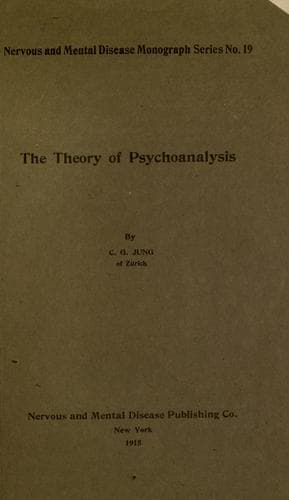
The Theory of PsychoanalysisJung, C. G. (Carl Gustav)
Science
The Theory of Psychoanalysis
Jung, C. G. (Carl Gustav)
Neuroses; Psychoanalysis; Psychology, Pathological; Sex
and not as a resistance against the conscious admittance of a painful
remembrance.
You will ask with astonishment, to what aim the patient contrives such a
phantasy? You will even be inclined to suggest that the physician forced
the patient to invent it, otherwise she would probably never have
produced such an absurd idea. I do not venture to doubt that there have
been cases in which, by dint of the physician’s desire to find a cause,
especially under the influence of the shock-theory, the patient has been
brought to contrive such phantasies. But the physician would never have
come to this theory, had he not followed the patient’s line of thought,
thus taking part in this retrograde movement of the libido which we call
regression. The physician, consequently, only carried right through to
its consequence what the patient was afraid to carry out, namely, a
regression, a falling back of the libido to its former desires. The
analysis, in following the libido-regression, does not always follow the
exact way marked by its historical development, but very often rather a
later phantasy, which only partly depends on former realities. In our
case, only some of the circumstances are real, and it is but much later
that they get their great importance, namely, at the moment when the
libido regresses. Wherever the libido takes hold of a reminiscence, we
may expect that this reminiscence will be elaborated and altered, as
everything that is touched by the libido revives, takes on dramatic
form, and becomes systematized. We have to admit that, in our case,
almost the greater part of these phantasies became significant
subsequently, after the libido had made a regression, after it had taken
hold of everything that could be suitable, and had made out of all this
a phantasy. Then that phantasy, keeping pace with the retrograde
movement of the libido, came back at last to the father and put upon him
all the infantile sexual desires. Even so it was thought in ancient
times that the golden age of Paradise lay in the past! In the case
before us we know that all the phantasies brought out by analysis did
become subsequently of importance. From this standpoint only, we are not
able to explain the beginning of the neurosis; we should constantly move
in a circle. The critical moment for this neurosis was that in which the
girl and man were inclined to love one another, but in which an
inopportune sensitiveness on the part of the patient caused the
opportunity to slip by.
Public-domain text, read in full here on John Shaqi.
Reviews
Reviews
No reviews yet
Be the first to share your thoughts on this work.
Elsewhere in the archive
Join the Discussion
Join the discussion
Sign in to leave a comment or review.
Sign InorCreate an account