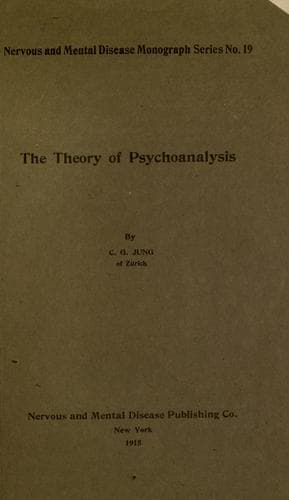
The Theory of PsychoanalysisJung, C. G. (Carl Gustav)
Science
The Theory of Psychoanalysis
Jung, C. G. (Carl Gustav)
Neuroses; Psychoanalysis; Psychology, Pathological; Sex
fled from his duties and his libido withdrew, at least partly, from the
tasks imposed by real life. In consequence, the libido became
introverted and directed towards an inner life. The libido followed the
path of regression: to a large extent phantasies replaced reality,
because the patient refused to overcome certain real difficulties.
Unconsciously the neurotic patient prefers—and very often consciously
too—his dreams and phantasies to reality. To bring him back to real life
and to the fulfilment of its necessary duties, the analysis proceeds
along the same false path of regression which has been taken by his
libido; so that the beginning of psychoanalysis looks as if it were
supporting the morbid tendencies of the patient. But psychoanalysis
follows these phantasies, these wrong paths, in order to restore the
libido, which is the valuable part of the phantasies, to the conscious
self and to the duties of the moment. This can only be done by bringing
the phantasies into the light of day, and along with them the libido
bound up with them. We might leave these unconscious phantasies to their
shadowy existence, if no libido were attached to them. It is unavoidable
that the patient, feeling himself at the beginning of analysis confirmed
in his regressive tendencies, leads his analytical interest, amid
increasing resistances, down to the depths of the shadowy world. We can
easily understand that any physician who is a normal person experiences
the greatest resistance towards the thoroughly morbid, regressive
tendency of the patient, since he feels quite certain that this tendency
is pathological. And this all the more because, as physician, he
believes he is right in refusing to give heed to his patient’s
phantasies. It is quite conceivable that the physician feels a repulsion
towards this tendency; it is undoubtedly repugnant to see how a person
is completely given up to such phantasies, finding only himself of any
importance and never ceasing to admire or despise himself. The esthetic
sense of normal people has, as a rule, little pleasure in neurotic
phantasies, even if it does not find them absolutely repulsive. The
psychoanalyst must put aside such esthetic judgment, just as every
physician must, who really tries to help his patients. He may not fear
any dirty work. Of course there are a great many patients physically
ill, who, without undergoing an exact examination or local treatment, do
recover by the use of general physical, dietetic, or suggestive means.
Severe cases can, however, only be helped by a more exact examination
and therapy, based on a profound knowledge of the illness. Our
psychotherapeutic methods hitherto have been like these general
measures. In slight cases they did no harm; on the contrary, they were
often of great service. But for a great many patients these measures
have proved inadequate. If they really can be helped, it will be by
psychoanalysis, which is not to say that psychoanalysis is a universal
panacea.
Public-domain text, read in full here on John Shaqi.
Reviews
Reviews
No reviews yet
Be the first to share your thoughts on this work.
Elsewhere in the archive
Join the Discussion
Join the discussion
Sign in to leave a comment or review.
Sign InorCreate an account