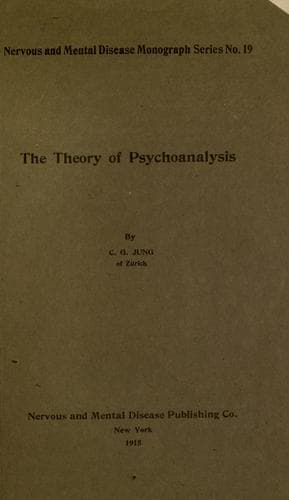
The Theory of PsychoanalysisJung, C. G. (Carl Gustav)
Science
The Theory of Psychoanalysis
Jung, C. G. (Carl Gustav)
Neuroses; Psychoanalysis; Psychology, Pathological; Sex
Such a sneer proceeds only from ill-natured criticism. We know
very well that psychoanalysis fails in many cases. As everybody knows,
we shall never be able to cure all illnesses.
This “diving” work of analysis brings dirty matter piecemeal out of the
slime, which must then be cleansed before we can tell its value. The
dirty phantasies are valueless and are thrown aside, but the libido
actuating them is of value and this, after cleansing, becomes
serviceable again. To the psychoanalyst, as to every specialist, it will
sometimes seem that the phantasies have also a value of their own, and
not only by reason of the libido linked with them. But their value is
not, in the first instance, for the patient. For the physician, these
phantasies have a scientific value, just as if is of special interest to
the surgeon to know whether the pus contained staphylococci or
streptococci. To the patient it is all the same, and for him, it is
better that the doctor conceal his scientific interest, in order not to
tempt him to have greater pleasure than necessary in his phantasies. The
etiological importance which is attached to these phantasies,
incorrectly, to my mind, explains why so much room is given up in
psychoanalytic literature to the extensive discussion of the various
sexual phantasies. Once if is known that absolutely nothing is
impossible in the sphere of sexual phantasy, the former estimate of
these phantasies will disappear, and therewith the endeavor to discover
in them an etiological import. Nor will the most extended discussion of
these cases ever be able to exhaust this sphere.
Public-domain text, read in full here on John Shaqi.
Reviews
Reviews
No reviews yet
Be the first to share your thoughts on this work.
Elsewhere in the archive
Join the Discussion
Join the discussion
Sign in to leave a comment or review.
Sign InorCreate an account