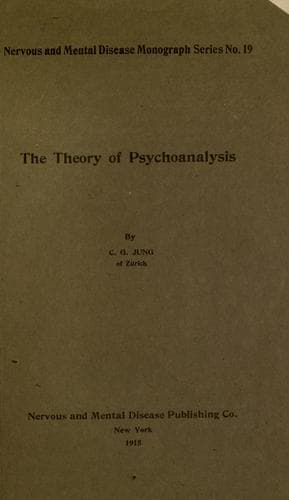
The Theory of PsychoanalysisJung, C. G. (Carl Gustav)
Science
The Theory of Psychoanalysis
Jung, C. G. (Carl Gustav)
Neuroses; Psychoanalysis; Psychology, Pathological; Sex
culture, this institution may be commended as a splendid instance of
social control and education, which served humanity during the space of
two thousand years. So long as the Christian Church of the Middle Ages
was capable of being the guardian of culture and science, in which rôle
her success was, in part, due to her wide toleration of the secular
element, confession was an admirable method for the education of the
people. But confession lost its greatest value, at least for the more
educated, as soon as the Church was unable to maintain her leadership
over the more emancipated portion of the community and became incapable,
through her rigidity, of following the intellectual life of the nations.
The more highly educated men of to-day do not want to be guided by a
belief or a rigid dogma; they want to understand. Therefore, they put
aside everything that they do not understand, and the religious symbol
is very little accessible for general understanding. The sacrificium
intellectus is an act of violence, to which the moral conscience of the
highly developed man is opposed. But in a large number of cases,
transference to, and dependence upon the analyst could be considered as
a sufficient end, with a definite therapeutic effect, if the analyst
were in every respect a great personality, capable and competent to
guide the patients given into his charge and to be a father of his
people. But a modern, mentally-developed person desires to guide
himself, and to stand on his own feet. He wants to take the helm in his
own hands; the steering has too long been done by others. He wants to
understand; in other words, he wants to be a grown-up person. It is much
easier to be guided, but this no longer suits the well-educated of the
present time, for they feel the necessity of the moral independence
demanded by the spirit of our time. _Modern humanity demands moral
autonomy._ Psychoanalysis has to allow this claim, and refuses to guide
and to advise. The psychoanalytic physician knows his own shortcomings
too well, and therefore cannot believe that he can be father and leader.
His highest ambition must only consist in educating his patients to
become independent personalities, and in freeing them from their
unconscious dependency within infantile limitations. Psychoanalysis has
therefore to analyze the transference, a task left untouched by the
priest. In so doing, the unconscious dependence upon the physician is
cut off, and the patient is put upon his own feet; this at least is the
end at which the physician aims.
The Analysis of the Transference
Public-domain text, read in full here on John Shaqi.
Reviews
Reviews
No reviews yet
Be the first to share your thoughts on this work.
Elsewhere in the archive
Join the Discussion
Join the discussion
Sign in to leave a comment or review.
Sign InorCreate an account