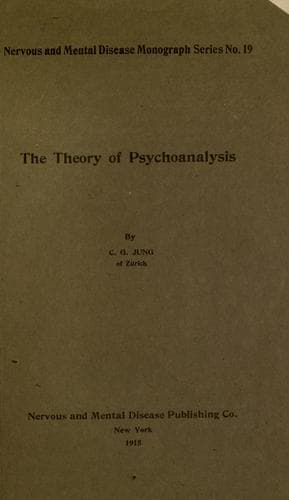
The Theory of PsychoanalysisJung, C. G. (Carl Gustav)
Science
The Theory of Psychoanalysis
Jung, C. G. (Carl Gustav)
Neuroses; Psychoanalysis; Psychology, Pathological; Sex
bestow great attention upon him, but in addition he gets a relationship
outside the family, and thus fulfils a necessary duty of life. The
therapeutical success so often to be seen at the same time fortifies the
patient’s belief that this new-gained situation is an excellent one.
Here we can easily understand that the patient is not in the least
inclined to abandon this newly-found advantage. If it depended upon him,
he would be forever associated with his physician. In consequence, he
begins to produce all kinds of phantasies, in order to find possible
ways of maintaining the association with his physician. He makes the
greatest resistances towards his physician, when the latter tries to
dissolve the transference. At the same time, we must not forget that for
our patients the acquisition of a relationship outside the family is one
of the most important duties of life, and one, moreover, which up to
this moment they had failed or but very imperfectly succeeded in
accomplishing. I must oppose myself energetically to the view that we
always mean by this relationship outside the family, a sexual relation
in its popular sense. This is the misunderstanding fallen into by so
many neurotic people, who believe that a right attitude toward reality
is only to be found by way of concrete sexuality. There are even
physicians, not psychoanalysts, who are of the same conviction. But this
is the primitive adaptation which we find among uncivilized people under
primitive conditions. If we lend uncritical support to this tendency of
neurotic people to adapt themselves in an infantile way, we just
encourage them in the infantilism from which they are suffering. The
neurotic patient has to learn that higher adaptation which is demanded
by life from civilized and grown-up people. Whoever has a tendency to
sink lower, will proceed to do so; for this end he does not need
psychoanalysis. But we must be careful not to fall into the opposite
extreme and believe that we can create by analysis great personalities.
Psychoanalysis stands above traditional morality. It follows no
arbitrary moral standard. It is only a means to bring to light the
individual trends, and to develop and harmonize them as perfectly as
possible.
Public-domain text, read in full here on John Shaqi.
Reviews
Reviews
No reviews yet
Be the first to share your thoughts on this work.
Elsewhere in the archive
Join the Discussion
Join the discussion
Sign in to leave a comment or review.
Sign InorCreate an account