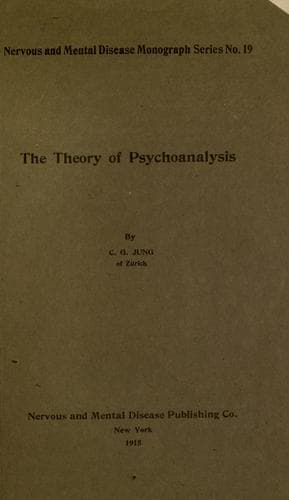
The Theory of PsychoanalysisJung, C. G. (Carl Gustav)
Science
The Theory of Psychoanalysis
Jung, C. G. (Carl Gustav)
Neuroses; Psychoanalysis; Psychology, Pathological; Sex
Conscious thinking would be quite insufficiently characterized, if we
considered it only from its historical determinants. For its complete
valuation, we have unquestionably to consider its teleological or
prospective meaning as well. If we pursued the history of the English
Parliament back to its first origin, we should certainly arrive at a
perfect understanding of its development, and the determination of its
present form. But we should know nothing about its prospective function,
that is, about the work which it has to accomplish now, and in the
future. The same thing is to be said about dreams. Their prospective
function has been valued only by superstitious peoples and times, but
probably there is much truth in their view. Not that we pretend that
dreams have any prophetic foreboding, but we suggest, that there might
be a possibility of discovering in their unconscious material those
future combinations which are subliminal just because they have not
reached the distinctiveness or the intensity which consciousness
requires. Here I am thinking of those indistinct presentments of the
future which we sometimes have, which are nothing else than subliminal
combinations, the objective value of which we are not able to
apperceive. The future tendencies of the patient are elaborated by this
indirect analysis, and, if this work is successful, the convalescent
passes out of treatment and out of his half-infantile state of
transference into life, which has been inwardly carefully prepared for,
which has been chosen by himself, and to which, after many
deliberations, he has at last made up his mind.
CHAPTER X
Some General Remarks on Psychoanalysis
As may easily be understood, psychoanalysis will never do for polyclinic
work, and will therefore always remain in the hands of those few who,
because of their innate and trained psychological faculties, are
particularly apt and have a special liking for this profession. Just as
not every physician makes a good surgeon, so neither will every one make
a good psychoanalyst. The predominant psychological character of
psychoanalytic work will make it difficult for doctors to monopolize it.
Sooner or later other faculties will master it, either for practical
uses or for its theoretical interest. Of course the treatment must
remain confined entirely to the hands of responsible scientific people.
Public-domain text, read in full here on John Shaqi.
Reviews
Reviews
No reviews yet
Be the first to share your thoughts on this work.
Elsewhere in the archive
Join the Discussion
Join the discussion
Sign in to leave a comment or review.
Sign InorCreate an account