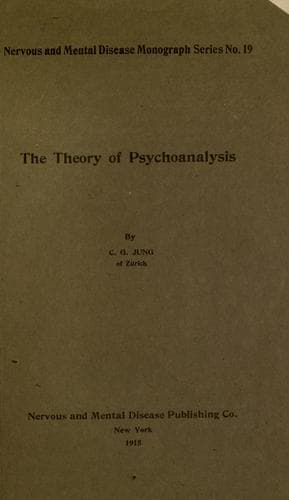
The Theory of PsychoanalysisJung, C. G. (Carl Gustav)
Science
The Theory of Psychoanalysis
Jung, C. G. (Carl Gustav)
Neuroses; Psychoanalysis; Psychology, Pathological; Sex
So long as official science excludes psychoanalysis from general
discussion, as pure nonsense, we cannot be astonished if those belonging
to other faculties master this material even before the medical
profession. And this will occur the more because psychoanalysis is a
general psychological method of investigation, as well as a heuristic
principle of the first rank in all departments of mental science
(“Geisteswissenschaften”). Chiefly through the work of the Zürich
School, the possibility of applying psychoanalysis to the domain of the
mental diseases has been demonstrated. Psychoanalytical investigation of
dementia præcox, for instance, brought us the most valuable insight into
the psychological structure of this remarkable disease. It would lead me
too far were I to demonstrate to you the results of those
investigations. The theory of the psychological determinants of this
disease is already in itself a vast territory. Even if I had to treat
but the symbolic problems of dementia præcox I should be obliged to lay
before you so much material, that I could not possibly master it within
the limits of these lectures, which must give a general survey.
The question of dementia præcox has become so extraordinarily
complicated because of the quite recent incursion on the part of
psychoanalysis into the domains of mythology and comparative religion,
whence we have derived a deeper insight into ethical psychological
symbolism. Those who are well-acquainted with the symbolism of dreams
and of dementia præcox have been greatly impressed by the striking
parallelism between modern individual symbols and those found in
folk-lore. The extraordinary parallelism between ethnic symbolism and
that of dementia præcox is remarkably clear. This fact induced me to
make an extended comparative investigation of individual and ethnic
symbolism, the results of which have been recently published.[11] This
complication of psychology with the problem of mythology makes it
impossible for me to demonstrate to you my conception of dementia
præcox. For the same reasons, I must forego the discussion of the
results of psychoanalytic investigation in the domain of mythology and
comparative religions. It would be impossible to do this without setting
forth all the material belonging to it. The main result of these
investigations is, for the moment, the knowledge of the far-reaching
parallelisms between the ethnical and the individual symbolisms. From
the present position of this work, we can scarcely conceive what a vast
perspective may result from this comparative ethnopsychology. Through
the study of mythology, the psychoanalytical knowledge of the nature of
the unconscious processes we may expect to be enormously enriched and
deepened.
Public-domain text, read in full here on John Shaqi.
Reviews
Reviews
No reviews yet
Be the first to share your thoughts on this work.
Elsewhere in the archive
Join the Discussion
Join the discussion
Sign in to leave a comment or review.
Sign InorCreate an account