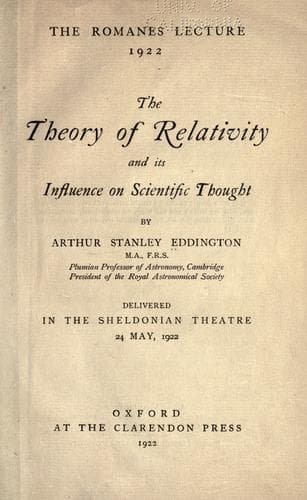
The theory of relativity and its influence on scientific thoughtEddington, Arthur Stanley, Sir
Philosophy
The theory of relativity and its influence on scientific thought
Eddington, Arthur Stanley, Sir
Relativity (Physics); Science -- Philosophy
Einstein, recognizing that in the phenomena of gravitation he was not
dealing with a 'tug' but with a curvature of the world, had to
reconsider the law of gravitation. He could not make any possible law of
curvature correspond exactly with the previously assumed law of tugging.
Thus he was led to propound a new law of gravitation--a law which in
most practical cases differs very little from that of Newton, although
it has an essentially different foundation. I need not here dwell on the
very remarkable way in which Einstein's emendation of the law of
gravitation has been confirmed both by the anomalous secular change in
the orbit of the planet Mercury, and by the observed displacement of the
stars near the sun during the total eclipse of 1919. I might, however,
remind you that in the latter observation the point at issue between
Newton's and Einstein's theory was not the _existence_ of a deflexion of
light-rays passing near the sun but the amount of the deflexion,
Einstein predicting twice the deflexion possible on the Newtonian
theory. The larger deflexion was quantitatively confirmed by the eclipse
observations. Einstein's main achievement is a new law, not a new
explanation, of gravitation. He attributes the gravitation of massive
bodies to a curvature of the world in the region surrounding them and so
throws a flood of light on the whole problem; but he is not primarily
concerned to explain how material bodies produce (or are associated
with) this curvature of the world around them, nor how this curvature is
made subject to a law. Although it would be an entire misunderstanding
of Einstein's attitude in propounding the general relativity theory to
regard it as a search for an explanation of gravitation, nevertheless I
think that the further following up of his ideas has led to a genuine
explanation as complete as could be desired. But I am not going to give
you the explanation in this lecture; sometimes an explanation requires a
great deal of explaining.[7]
Public-domain text, read in full here on John Shaqi.
Reviews
Reviews
No reviews yet
Be the first to share your thoughts on this work.
Join the Discussion
Join the discussion
Sign in to leave a comment or review.
Sign InorCreate an account