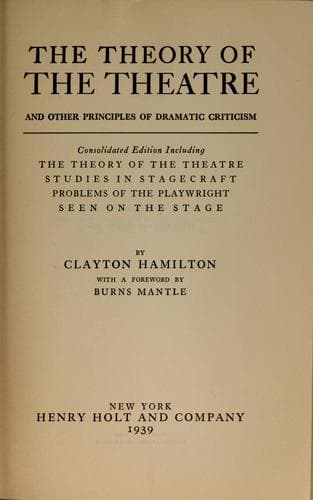
The Theory of the Theatre, and Other Principles of Dramatic CriticismHamilton, Clayton Meeker
History
The Theory of the Theatre, and Other Principles of Dramatic Criticism
Hamilton, Clayton Meeker
Drama -- History and criticism -- Theory, etc.; Theater
In all the arts except the acted drama, it is easy even for the layman to
distinguish work which is immediate and momentary from work which is
permanent and real. It was the turbulent untutored crowd that clamored
loudest in demanding that the Dewey Arch should be rendered permanent in
marble: it was only the artists and the art-critics who were satisfied by
the monument in its ephemeral state of frame and plaster. But in the drama,
the layman often finds it difficult to distinguish between a piece intended
merely for immediate entertainment and a piece that incorporates the
Intention of Permanence. In particular he almost always fails to
distinguish between what is really a character and what is merely an acting
part. When a dramatist really creates a character, he imagines and projects
a human being so truly conceived and so clearly presented that any average
man would receive the impression of a living person if he were to read in
manuscript the bare lines of the play. But when a playwright merely devises
an acting part, he does nothing more than indicate to a capable actor the
possibility of so comporting himself upon the stage as to convince his
audience of humanity in his performance. From the standpoint of criticism,
the main difficulty is that the actor's art may frequently obscure the
dramatist's lack of art, and _vice versa_, so that a mere acting part may
seem, in the hands of a capable actor, a real character, whereas a real
character may seem, in the hands of an incapable actor, an indifferent
acting part. Rip Van Winkle, for example, was a wonderful acting part for
Joseph Jefferson; but it was, from the standpoint of the dramatist, not a
character at all, as any one may see who takes the trouble to read the
play. Beau Brummel, also, was an acting part rather than a character. And
yet the layman, under the immediate spell of the actor's representative
art, is tempted in such cases to ignore that the dramatist has merely
modeled an image in the sand.
Likewise, on a larger scale, the layman habitually fails to distinguish
between a mere theatric entertainment and a genuine drama. A genuine drama
always reveals through its imagined struggle of contesting wills some
eternal truth of human life, and illuminates some real phases of human
character. But a theatric entertainment may present merely a deftly
fabricated struggle between puppets, wherein the art of the actor is given
momentary exercise. To return to our comparison, a genuine drama is carved
out of marble, and incorporates, consciously or not, the Intention of
Permanence; whereas a mere theatric entertainment may be likened to a group
of figures sculptured in the sand.
Public-domain text, read in full here on John Shaqi.
Reviews
Reviews
No reviews yet
Be the first to share your thoughts on this work.
Elsewhere in the archive
Join the Discussion
Join the discussion
Sign in to leave a comment or review.
Sign InorCreate an account