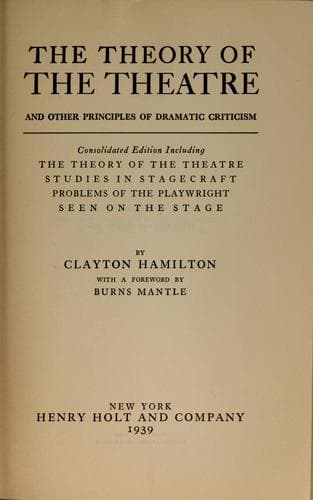
The Theory of the Theatre, and Other Principles of Dramatic CriticismHamilton, Clayton Meeker
History
The Theory of the Theatre, and Other Principles of Dramatic Criticism
Hamilton, Clayton Meeker
Drama -- History and criticism -- Theory, etc.; Theater
Since everybody knows already who Sir Arthur Wing Pinero is and what may be
expected of him, the only question for the critic, in considering a new
play from his practiced pen, is whether or not the author has succeeded in
advancing or maintaining the standard of his earlier and remembered
efforts. If, as in _The Wife Without a Smile_, he falls far below that
standard, the critic may condemn the play, and let the matter go at that.
Although the new piece may be discredited, the author's reputation will
suffer no abiding injury from the deep damnation of its taking off; for the
public will continue to remember the third act of _The Gay Lord Quex_, and
will remain assured that Sir Arthur Pinero is worth while. But when a play
by a new author comes up for consideration, the public needs to be told not
only whether the work itself has been well or badly done, but also whether
or not the unknown author seems to be inherently a person of importance,
from whom more worthy works may be expected in the future. The critic must
not only make clear the playwright's present actual accomplishment, but
must also estimate his promise. An author's first or second play is
important mainly--to use Whitman's phrase--as "an encloser of things to
be." The question is not so much what the author has already done as what
he is likely to do if he is given further hearings. It is in this sense
that the work of an unknown playwright requires and deserves more serious
consideration than the work of an acknowledged master. Accomplishment is
comparatively easy to appraise, but to appreciate promise requires
forward-looking and far-seeing eyes.
In the real sense, it matters very little whether an author's early plays
succeed or fail. The one point that does matter is whether, in either case,
the merits and defects are of such a nature as to indicate that the man
behind the work is inherently a man worth while. In either failure or
success, the sole significant thing is the quality of the endeavor. A young
author may fail for the shallow reason that he is insincere; but he may
fail even more decisively for the sublime reason that as yet his reach
exceeds his grasp. He may succeed because through earnest effort he has
done almost well something eminently worth the doing; or he may succeed
merely because he has essayed an unimportant and an easy task. Often more
hope for an author's future may be founded upon an initial failure than
upon an initial success. It is better for a young man to fail in a large
and noble effort than to succeed in an effort insignificant and mean. For
in labor, as in life, Stevenson's maxim is very often pertinent:--to travel
hopefully is frequently a better thing than to arrive.
Public-domain text, read in full here on John Shaqi.
Reviews
Reviews
No reviews yet
Be the first to share your thoughts on this work.
Elsewhere in the archive
Join the Discussion
Join the discussion
Sign in to leave a comment or review.
Sign InorCreate an account