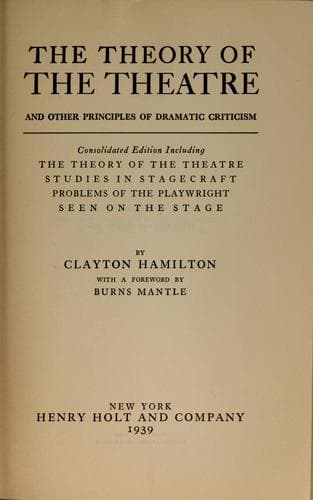
The Theory of the Theatre, and Other Principles of Dramatic CriticismHamilton, Clayton Meeker
History
The Theory of the Theatre, and Other Principles of Dramatic Criticism
Hamilton, Clayton Meeker
Drama -- History and criticism -- Theory, etc.; Theater
And in estimating the work of new and unknown authors, it is not nearly so
important for the critic to consider their present technical accomplishment
as it is for him to consider the sincerity with which they have endeavored
to tell the truth about some important phase of human life. Dramatic
criticism of an academic cast is of little value either to those who write
plays or to those who see them. The man who buys his ticket to the theatre
knows little and cares less about the technique of play-making; and for the
dramatist himself there are no ten commandments. I have been gradually
growing to believe that there is only one commandment for the
dramatist,--that he shall tell the truth; and only one fault of which a
play is capable,--that, as a whole or in details, it tells a lie. A play is
irretrievably bad only when the average theatre-goer--a man, I mean, with
no special knowledge of dramatic art--viewing what is done upon the stage
and hearing what is said, revolts instinctively against it with a feeling
that I may best express in that famous sentence of Assessor Brack's,
"People don't do such things." A play that is truthful at all points will
never evoke this instinctive disapproval; a play that tells lies at certain
points will lose attention by jangling those who know.
The test of truthfulness is the final test of excellence in drama. In
saying this, of course, I do not mean that the best plays are realistic in
method, naturalistic in setting, or close to actuality in subject-matter.
_The Tempest_ is just as true as _The Merry Wives of Windsor_, and _Peter
Pan_ is just as true as _Ghosts_. I mean merely that the people whom the
dramatist has conceived must act and speak at all points consistently with
the laws of their imagined existence, and that these laws must be in
harmony with the laws of actual life. Whenever people on the stage fail of
this consistency with law, a normal theatre-goer will feel instinctively,
"Oh, no, he did _not_ do that," or, "Those are _not_ the words she said."
It may safely be predicated that a play is really bad only when the
audience does not believe it; for a dramatist is not capable of a single
fault, either technical or otherwise, that may not be viewed as one phase
or another of untruthfulness.
XI
THE EFFECT OF PLAYS UPON THE PUBLIC
Public-domain text, read in full here on John Shaqi.
Reviews
Reviews
No reviews yet
Be the first to share your thoughts on this work.
Elsewhere in the archive
Join the Discussion
Join the discussion
Sign in to leave a comment or review.
Sign InorCreate an account