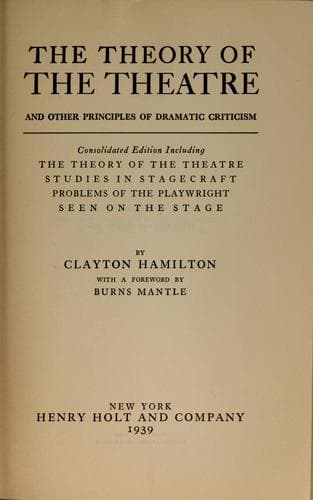
The Theory of the Theatre, and Other Principles of Dramatic CriticismHamilton, Clayton Meeker
History
The Theory of the Theatre, and Other Principles of Dramatic Criticism
Hamilton, Clayton Meeker
Drama -- History and criticism -- Theory, etc.; Theater
Returning now to that clever title of Mr. Shaw's, we may define an
unpleasant play as one which interests the intellect without at the same
time awakening a positive response from the emotions; and we may define a
pleasant play as one which not only stimulates thought but also elicits
sympathy. To any one who has thoroughly considered the conditions governing
theatric art, it should be evident _a priori_ that pleasant plays are
better suited for service in the theatre than unpleasant plays. This truth
is clearly illustrated by the facts of Mr. Shaw's career. As a matter of
history, it will be remembered that his vogue in our theatres has been
confined almost entirely to his pleasant plays. All four of them have
enjoyed a profitable run; and it is to _Candida_, the best of his pleasant
plays, that, in America at least, he owes his fame. Of the three unpleasant
plays, _The Philanderer_ has never been produced at all; _Widower's Houses_
has been given only in a series of special matinées; and _Mrs. Warren's
Profession_, though it was enormously advertised by the fatuous
interference of the police, failed to interest the public when ultimately
it was offered for a run.
_Mrs. Warren's Profession_ is just as interesting to the thoughtful reader
as _Candida_. It is built with the same technical efficiency, and written
with the same agility and wit; it is just as sound and true, and therefore
just as moral; and as a criticism, not so much of life as of society, it is
indubitably more important. Why, then, is _Candida_ a better work? The
reason is that the unpleasant play is interesting merely to the intellect
and leaves the audience cold, whereas the pleasant play is interesting also
to the emotions and stirs the audience to sympathy. It is possible for the
public to feel sorry for Morell; it is even possible for them to feel sorry
for Marchbanks: but it is absolutely impossible for them to feel sorry for
Mrs. Warren. The multitude instinctively demands an opportunity to
sympathise with the characters presented in the theatre. Since the drama is
a democratic art, and the dramatist is not the monarch but the servant of
the public, the voice of the people should, in this matter of pleasant and
unpleasant plays, be considered the voice of the gods. This thesis seems to
me axiomatic and unsusceptible of argument. Yet since it is continually
denied by the professed "uplifters" of the stage, who persist in looking
down upon the public and decrying the wisdom of the many, it may be
necessary to explain the eternal principle upon which it is based. The
truth must be self-evident that theatre-goers are endowed with a certain
inalienable right--namely, the pursuit of happiness. The pursuit of
happiness is the most important thing in the world; because it is nothing
less than an endeavor to understand and to appreciate the true, the
beautiful, and the good. Happiness comes of loving things which are
Public-domain text, read in full here on John Shaqi.
Reviews
Reviews
No reviews yet
Be the first to share your thoughts on this work.
Elsewhere in the archive
Join the Discussion
Join the discussion
Sign in to leave a comment or review.
Sign InorCreate an account