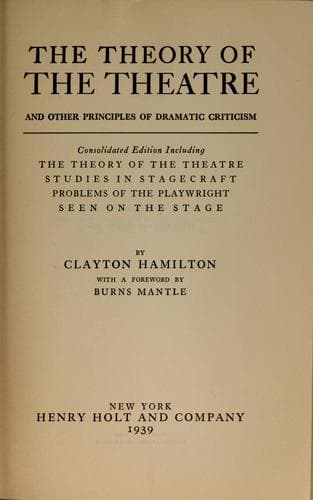
The Theory of the Theatre, and Other Principles of Dramatic CriticismHamilton, Clayton Meeker
History
The Theory of the Theatre, and Other Principles of Dramatic Criticism
Hamilton, Clayton Meeker
Drama -- History and criticism -- Theory, etc.; Theater
Yet the will is free:
Strong is the Soul, and wise, and beautiful:
The seeds of godlike power are in us still:
Gods are we, Bards, Saints, Heroes, if we will.--
Dumb judges, answer, truth or mockery?
XII
PLEASANT AND UNPLEASANT PLAYS
The clever title, _Plays Pleasant and Unpleasant_, which Mr. Bernard Shaw
selected for the earliest issue of his dramatic writings, suggests a theme
of criticism that Mr. Shaw, in his lengthy prefaces, might profitably have
considered if he had not preferred to devote his entire space to a
discussion of his own abilities. In explanation of his title, the author
stated only that he labeled his first three plays Unpleasant for the reason
that "their dramatic power is used to force the spectator to face
unpleasant facts." This sentence, of course, is not a definition, since it
merely repeats the word to be explained; and therefore, if we wish to find
out whether or not an unpleasant play is of any real service in the
theatre, we shall have to do some thinking of our own.
It is an axiom that all things in the universe are interesting. The word
_interesting_ means _capable of awakening some activity of human mind_; and
there is no imaginable topic, whether pleasant or unpleasant, which is not,
in one way, or another, capable of this effect. But the activities of the
human mind are various, and there are therefore several different sorts of
interest. The activity of mind awakened by music over waters is very
different from that awakened by the binomial theorem. Some things interest
the intellect, others the emotions; and it is only things of prime
importance that interest them both in equal measure. Now if we compare the
interest of pleasant and unpleasant topics, we shall see at once that the
activity of mind awakened by the former is more complete than that awakened
by the latter. A pleasant topic not only interests the intellect but also
elicits a positive response from the emotions; but most unpleasant topics
are positively interesting to the intellect alone. In so far as the
emotions respond at all to an unpleasant topic, they respond usually with a
negative activity. Regarding a thing which is unpleasant, the healthy mind
will feel aversion--which is a negative emotion--or else will merely think
about it with no feeling whatsoever. But regarding a thing which is
pleasant, the mind may be stirred through the entire gamut of positive
emotions, rising ultimately to that supreme activity which is Love. This
is, of course, the philosophic reason why the thinkers of pleasant thoughts
and dreamers of beautiful dreams stand higher in history than those who
have thought unpleasantness and have imagined woe.
Public-domain text, read in full here on John Shaqi.
Reviews
Reviews
No reviews yet
Be the first to share your thoughts on this work.
Elsewhere in the archive
Join the Discussion
Join the discussion
Sign in to leave a comment or review.
Sign InorCreate an account