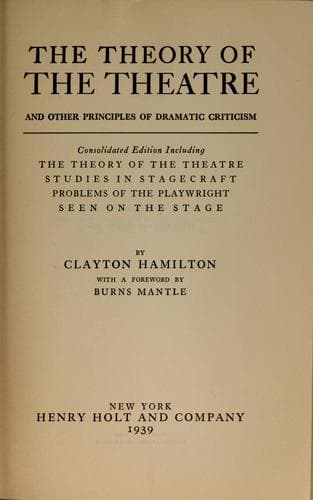
The Theory of the Theatre, and Other Principles of Dramatic CriticismHamilton, Clayton Meeker
History
The Theory of the Theatre, and Other Principles of Dramatic Criticism
Hamilton, Clayton Meeker
Drama -- History and criticism -- Theory, etc.; Theater
By a theme is meant some eternal principle, or truth, of human life--such a
truth as might be stated by a man of philosophic mind in an abstract and
general proposition--which the dramatist contrives to convey to his
auditors concretely by embodying it in the particular details of his play.
These details must be so selected as to represent at every point some phase
of the central and informing truth, and no incidents or characters must be
shown which are not directly or indirectly representative of the one thing
which, in that particular piece, the author has to say. The great plays of
the world have all grown endogenously from a single, central idea; or, to
vary the figure, they have been spun like spider-webs, filament after
filament, out of a central living source. But most of our native
playwrights seem seldom to experience this necessary process of the
imagination which creates. Instead of working from the inside out, they
work from the outside in. They gather up a haphazard handful of theatric
situations and try to string them together into a story; they congregate an
ill-assorted company of characters and try to achieve a play by letting
them talk to each other. Many of our playwrights are endowed with a sense
of situation; several of them have a gift for characterisation, or at least
for caricature; and most of them can write easy and natural dialogue,
especially in slang. But very few of them start out with something to say,
as Mr. Moody started out in _The Great Divide_ and Mr. Thomas in _The
Witching Hour_.
When a play is really about something, it is always possible for the critic
to state the theme of it in a single sentence. Thus, the theme of _The
Witching Hour_ is that every thought is in itself an act, and that
therefore thinking has the virtue, and to some extent the power, of action.
Every character in the piece was invented to embody some phase of this
central proposition, and every incident was devised to represent this
abstract truth concretely. Similarly, it would be easy to state in a single
sentence the theme of _Le Tartufe_, or of _Othello_, or of _Ghosts_. But
who, after seeing four out of five of the American plays that are produced
upon Broadway, could possibly tell in a single sentence what they were
about? What, for instance--to mention only plays which did not fail--was
_Via Wireless_ about, or _The Fighting Hope_, or even _The Man from Home_?
Each of these was in some ways an interesting entertainment; but each was
valueless as drama, because none of them conveyed to its auditors a theme
which they might remember and weave into the texture of their lives.
Public-domain text, read in full here on John Shaqi.
Reviews
Reviews
No reviews yet
Be the first to share your thoughts on this work.
Elsewhere in the archive
Join the Discussion
Join the discussion
Sign in to leave a comment or review.
Sign InorCreate an account