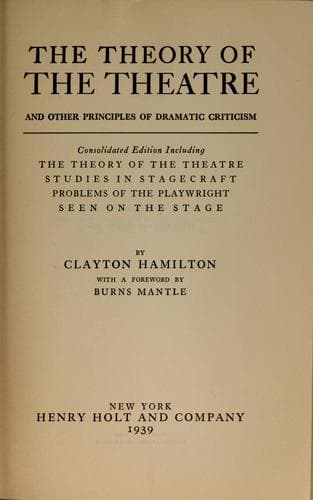
The Theory of the Theatre, and Other Principles of Dramatic CriticismHamilton, Clayton Meeker
History
The Theory of the Theatre, and Other Principles of Dramatic Criticism
Hamilton, Clayton Meeker
Drama -- History and criticism -- Theory, etc.; Theater
For the only sort of play that permits itself to be remembered is a play
that presents a distinct theme to the mind of the observer. It is ten years
since I have seen _Le Tartufe_ and six years since last I read it; and yet,
since the theme is unforgetable, I could at any moment easily reconstruct
the piece by retrospective imagination and summarise the action clearly in
a paragraph. But on the other hand, I should at any time find it impossible
to recall with sufficient clearness to summarise them, any of a dozen
American plays of the usual type which I had seen within the preceding six
months. Details of incident or of character or of dialogue slip the mind
and melt away like smoke into the air. To have seen a play without a theme
is the same, a month or two later, as not to have seen a play at all. But a
piece like _The Second Mrs. Tanqueray_, once seen, can never be forgotten;
because the mind clings to the central proposition which the play was built
in order to reveal, and from this ineradicable recollection may at any
moment proceed by psychologic association to recall the salient concrete
features of the action. To develop a play from a central theme is therefore
the sole means by which a dramatist may insure his work against the
iniquity of oblivion. In order that people may afterward remember what he
has said, it is necessary for him to show them clearly and emphatically at
the outset why he has undertaken to talk and precisely what he means to
talk about.
Most of our American playwrights, like Juliet in the balcony scene, speak,
yet they say nothing. They represent facts, but fail to reveal truths. What
they lack is purpose. They collect, instead of meditating; they invent,
instead of wondering; they are clever, instead of being real. They are avid
of details: they regard the part as greater than the whole. They deal with
outsides and surfaces, not with centralities and profundities. They value
acts more than they value the meanings of acts; they forget that it is in
the motive rather than in the deed that Life is to be looked for. For Life
is a matter of thinking and of feeling; all act is merely Living, and is
significant only in so far as it reveals the Life that prompted it. Give us
less of Living, more of Life, must ever be the cry of earnest criticism.
Enough of these mutitudinous, multifarious facts: tell us single, simple
truths. Give us more themes, and fewer fabrics of shreds and patches.
XIV
THE FUNCTION OF IMAGINATION
Public-domain text, read in full here on John Shaqi.
Reviews
Reviews
No reviews yet
Be the first to share your thoughts on this work.
Elsewhere in the archive
Join the Discussion
Join the discussion
Sign in to leave a comment or review.
Sign InorCreate an account