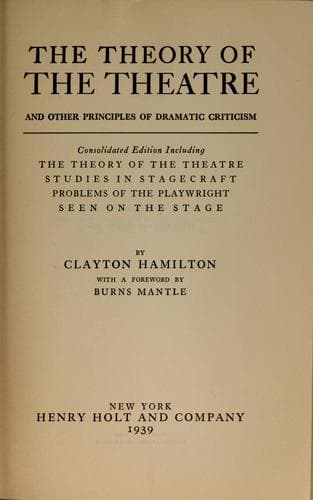
The Theory of the Theatre, and Other Principles of Dramatic CriticismHamilton, Clayton Meeker
History
The Theory of the Theatre, and Other Principles of Dramatic Criticism
Hamilton, Clayton Meeker
Drama -- History and criticism -- Theory, etc.; Theater
But now, lest we be led into misapprehension, let us understand clearly
that what we desire in the theatre is not new material, but rather a fresh
and vital treatment of such material as the playwright finds made to his
hand. After a certain philosophic critic had announced the startling thesis
that only some thirty odd distinct dramatic situations were conceivable,
Goethe and Schiller set themselves the task of tabulation, and ended by
deciding that the largest conceivable number was less than twenty. It is a
curious paradox of criticism that for new plays old material is best. This
statement is supported historically by the fact that all the great Greek
dramatists, nearly all of the Elizabethans, Corneille, Racine, Molière,
and, to a great extent, the leaders of the drama in the nineteenth century,
made their plays deliberately out of narrative materials already familiar
to the theatre-going public of their times. The drama, by its very nature,
is an art traditional in form and resumptive in its subject-matter. It
would be futile, therefore, for us to ask contemporary playwrights to
invent new narrative materials. Their fault is not that they deal with what
is old, but that they fail to make out of it anything which is new. If, in
the long run, they weary us, the reason is not that they are lacking in
invention, but that they are lacking in imagination.
That invention and imagination are two very different faculties, that the
second is much higher than the first, that invention has seldom been
displayed by the very greatest authors, whereas imagination has always been
an indispensable characteristic of their work,--these points have all been
made clear in a very suggestive essay by Professor Brander Matthews, which
is included in his volume entitled _Inquiries and Opinions_. It remains for
us to consider somewhat closely what the nature of imagination is.
Imagination is nothing more or less than the faculty for
_realisation_,--the faculty by which the mind makes real unto itself such
materials as are presented to it. The full significance of this definition
may be made clear by a simple illustration.
Public-domain text, read in full here on John Shaqi.
Reviews
Reviews
No reviews yet
Be the first to share your thoughts on this work.
Elsewhere in the archive
Join the Discussion
Join the discussion
Sign in to leave a comment or review.
Sign InorCreate an account