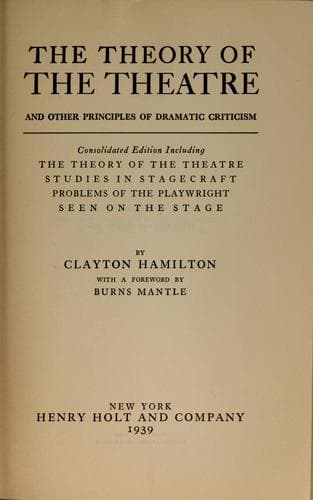
The Theory of the Theatre, and Other Principles of Dramatic CriticismHamilton, Clayton Meeker
History
The Theory of the Theatre, and Other Principles of Dramatic Criticism
Hamilton, Clayton Meeker
Drama -- History and criticism -- Theory, etc.; Theater
Suppose that some morning at breakfast you pick up a newspaper and read
that a great earthquake has overwhelmed Messina, killing countless
thousands and rendering an entire province desolate. You say, "How very
terrible!"--after which you go blithely about your business, untroubled,
undisturbed. But suppose that your little girl's pet pussy-cat happens to
fall out of the fourth-story window. If you chance to be an author and have
an article to write that morning, you will find the task of composition
heavy. Now, the reason why the death of a single pussy-cat affects you more
than the death of a hundred thousand human beings is merely that you
realise the one and do not realise the other. You do not, by the action of
imagination, make real unto yourself the disaster at Messina; but when you
see your little daughter's face, you at once and easily imagine woe.
Similarly, on the largest scale, we go through life realising only a very
little part of all that is presented to our minds. Yet, finally, we know of
life only so much as we have realised. To use the other word for the same
idea,--we know of life only so much as we have imagined. Now, whatever of
life we make real unto ourselves by the action of imagination is for us
fresh and instant and, in a deep sense, new,--even though the same
materials have been realised by millions of human beings before us. It is
new because we have made it, and we are different from all our
predecessors. Landor imagined Italy, realised it, made it instant and
afresh. In the subjective sense, he created Italy, an Italy that had never
existed before,--Landor's Italy. Later Browning came, with a new
imagination, a new realisation, a new creation,--Browning's Italy. The
materials had existed through immemorable centuries; Landor, by
imagination, made of them something real; Browning imagined them again and
made of them something new. But a Cook's tourist hurrying through Italy is
likely, through deficiency of imagination, not to realise an Italy at all.
He reviews the same materials that were presented to Landor and to
Browning, but he makes nothing out of them. Italy for him is tedious, like
a twice-told tale. The trouble is not that the materials are old, but that
he lacks the faculty for realising them and thereby making of them
something new.
Public-domain text, read in full here on John Shaqi.
Reviews
Reviews
No reviews yet
Be the first to share your thoughts on this work.
Elsewhere in the archive
Join the Discussion
Join the discussion
Sign in to leave a comment or review.
Sign InorCreate an account