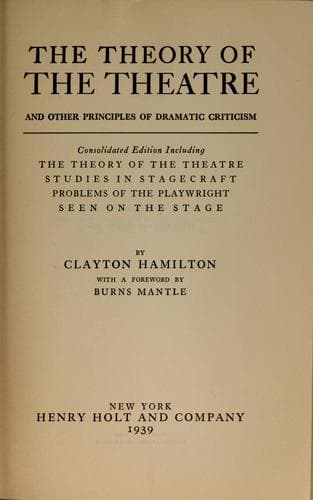
The Theory of the Theatre, and Other Principles of Dramatic CriticismHamilton, Clayton Meeker
History
The Theory of the Theatre, and Other Principles of Dramatic Criticism
Hamilton, Clayton Meeker
Drama -- History and criticism -- Theory, etc.; Theater
A great many of our contemporary playwrights travel like Cook's tourists
through the traditional subject-matter of the theatre. They stop off here
and there, at this or that eternal situation; but they do not, by
imagination, make it real. Thereby they miss the proper function of the
dramatist, which is to imagine some aspect of the perennial struggle
between human wills so forcibly as to make us realise it, in the full sense
of the word,--realise it as we daily fail to realise the countless
struggles we ourselves engage in. The theatre, rightly considered, is not a
place in which to escape from the realities of life, but a place in which
to seek refuge from the unrealities of actual living in the contemplation
of life realised,--life made real by imagination.
The trouble with most ineffective plays is that the fabricated life they
set before us is less real than such similar phases of actual life as we
have previously realised for ourselves. We are wearied because we have
already unconsciously imagined more than the playwright professionally
imagines for us. With a great play our experience is the reverse of this.
Incidents, characters, motives which we ourselves have never made
completely real by imagination are realised for us by the dramatist.
Intimations of humanity which in our own minds have lain jumbled
fragmentary, like the multitudinous pieces of a shuffled picture-puzzle,
are there set orderly before us, so that we see at last the perfect
picture. We escape out of chaos into life.
This is the secret of originality: this it is that we desire in the
theatre:--not new material, for the old is still the best; but familiar
material rendered new by an imagination that informs it with significance
and makes it real.
INDEX
Adams, Maude, 60.
Addison, Joseph, 79;
_Cato_, 79.
Ade, George, 56;
_Fables in Slang_, 56;
_The College Widow_, 41.
_Admirable Crichton, The_, 113.
Aeschylus, 5, 6, 135.
_After Blenheim_, 228.
_Aiglon, L'_, 67, 68.
_Alice-Sit-by-the-Fire_, 157.
Allen, Viola, 109.
Alleyn, Edward, 163.
_All for Love_, 17.
Alma-Tadema, Sir Lawrence, 92.
_Antony_, 140, 142.
_Antony and Cleopatra_, 16.
Aristophanes, 202.
Aristotle, 18.
Arnold, Matthew, 8, 19, 205, 221.
_As You Like It_, 38, 48, 51, 61, 62, 77, 78, 92, 100, 172, 186, 220.
_Atalanta in Calydon_, 20.
Augier, Emile, 9, 141.
_Autobiography of Joseph Jefferson_, 103.
_Autocrat of the Breakfast-Table, The_, 178.
Bannister, John, 86.
Banville, Théodore de, 66.
Barrie, James Matthew, 204, 205, 206, 219;
_Alice-Sit-by-the-Fire_, 157;
_Peter Pan_, 215;
_The Admirable Crichton_, 113;
_The Professor's Love Story_, 157.
Barry, Elizabeth, 70, 80.
Barrymore, Ethel, 157.
_Bartholomew Fair_, 202.
_Beau Brummel_, 70, 114, 210.
Beaumont, Francis, 28;
_The Maid's Tragedy_, 28.
_Becket_, 19, 72.
Béjart, Armande, 62, 63, 71.
Béjart, Magdeleine, 62, 71.
Public-domain text, read in full here on John Shaqi.
Reviews
Reviews
No reviews yet
Be the first to share your thoughts on this work.
Elsewhere in the archive
Join the Discussion
Join the discussion
Sign in to leave a comment or review.
Sign InorCreate an account