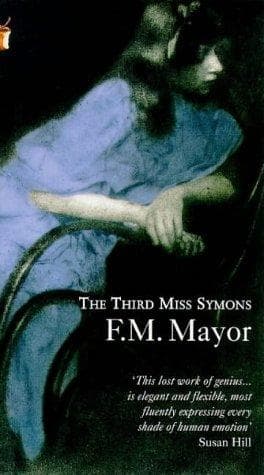
The Third Miss SymonsMayor, F. M. (Flora Macdonald)
General
The Third Miss Symons
Mayor, F. M. (Flora Macdonald)
England -- Social life and customs -- 19th century -- Fiction; Single women -- Fiction
The postcard made Henrietta inclined to back out of Dante. But by this
time she had arranged to read with a neighbour, Carrie Bostock, so she
had to make a start. They did start, but as they neither understood the
Italian, nor the translation, nor the notes, they found continual
excuses for not reading, till Carrie boldly suggested "I Promessi
Sposi," which went much better. They did not read for long, however, for
Carrie became engaged, it seemed to Henrietta that everybody she knew
was becoming engaged, and Carrie considered her engagement an occupation
which gave her no time for anything else, certainly no time for Italian.
Henrietta found she did not read by herself. The two years away from
school made it difficult to start. Perhaps it may seem strange that a
girl who had been so eager at school, should not care to work by herself
at home. But when there are no competitors and no Miss Arundel, work
loses much of its zest for everyone except the real student, who is
rarely to be found among men, still more rarely among women. And the
last thing Henrietta would ever be was unusual.
Clever, interesting schoolgirls are not at all uncommon, though not so
general as clever, interesting children. But there are few who remain
clever and interesting when they grow up. Uninspiring surroundings, and
contact with life, or mere accumulation of years, take something away.
Or perhaps it simply is that when they are grown up they are judged by a
more severe standard. Miss Arundel had been disappointed again and
again. But she would not have been surprised that Henrietta let
everything go, for she had always observed in her an unfortunate strain
of weakness.
Besides being weak, Henrietta was always affected by the people she was
with, and the atmosphere of home life was not encouraging to study.
"Reading Italian, my dear?" her mother would say. "Oh, can't you find
anything better to do than that? Surely there must be some mending;"
while her father advised her, through her mother, "not to become too
clever; it was a great pity for a girl to get too clever."
After all, there seemed no earthly reason why she should read Italian;
it gave no pleasure to herself or to anyone else. So she spent most of
the long leisure hours sitting by the window and thinking. She often
said to herself the verse of a poem then just published by Christina
Rossetti. She had seen it on a visit, copied it out, and learned it:
"Downstairs I laugh and sport and jest with all,
But in my solitary room above
I turn my face in silence to the wall:
My heart is breaking for a little love."
Public-domain text, read in full here on John Shaqi.
Reviews
Reviews
No reviews yet
Be the first to share your thoughts on this work.
Join the Discussion
Join the discussion
Sign in to leave a comment or review.
Sign InorCreate an account