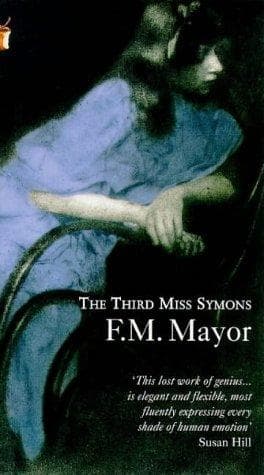
The Third Miss SymonsMayor, F. M. (Flora Macdonald)
General
The Third Miss Symons
Mayor, F. M. (Flora Macdonald)
England -- Social life and customs -- 19th century -- Fiction; Single women -- Fiction
There would have been more chance for her, if only she could have become
in the least interested. She tried the French Revolution next term for
a change, but liked it no better than Aristotle. Intellectual life was
dead and buried in her long ago. What would have really suited her best
in the present circumstances would have been shorthand and type-writing,
but at that time no such occupation was open to her.
She would perhaps have jogged on indefinitely at the lectures, if Miss
Gurney, whose great interest was novelty and change, and whose abstracts
of learned books had lately become much less voluminous, had not jumped
at a suggestion to take a delicate niece abroad, and proposed that
Henrietta should come too. So Henrietta consented, and with little
regret they gave up the lodgings, and said good-bye to learning.
CHAPTER IX
Henrietta paid her father a visit before they started abroad. The
promise of the first days was amply fulfilled; the whole house was
happy, and Henrietta was touched by the warmth of her welcome. After the
squalor of lodgings home was pleasant, and her father's invitation was
cordial: "Henrietta, why don't you stay with us? Mildred," with a fond
look at his wife, "never will allow your room to be used; it's always
ready waiting for you."
It was a temptation to Henrietta, but she refused partly from pride,
from a feeling that she ought not to disturb the present comfort, but
also because it was getting a principle with her, as apparently with
many middle-aged Englishwoman, that she must always be going abroad. Yet
she knew that Miss Gurney did not particularly want to have her, and had
invited her more from laziness than from anything else.
They went abroad--it was to the Italian Lakes--and a life of sitting in
the sun, walking up and down promenades, short drives, and making and
unmaking of desultory friendships began. They grumbled a good deal to
third parties, but still they were happy enough, according to their low
standard of happiness.
Public-domain text, read in full here on John Shaqi.
Reviews
Reviews
No reviews yet
Be the first to share your thoughts on this work.
Join the Discussion
Join the discussion
Sign in to leave a comment or review.
Sign InorCreate an account