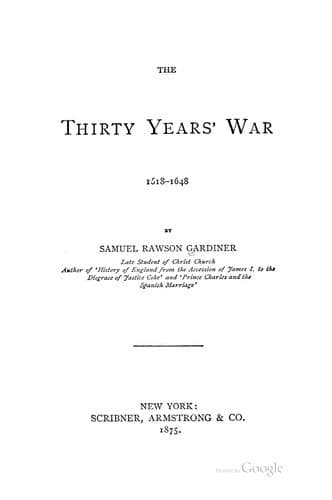
The Thirty Years' War, 1618-1648Gardiner, Samuel Rawson
History
The Thirty Years' War, 1618-1648
Gardiner, Samuel Rawson
Thirty Years' War, 1618-1648
[Sidenote: § 11. Impossibility of reconciling Gustavus and Wallenstein.]
Such terms would probably have met with opposition. But the real point
of difference lay elsewhere. Wallenstein would have restored the old
unity of the Empire, of which he hoped to be the inspiring genius.
Gustavus pressed for the formation of a separate Protestant league, if
not under his own guidance, at least in close alliance with Sweden.
Wallenstein asked for confidence in himself and the Emperor. Gustavus
had no confidence in either.
[Sidenote: § 12. Hesitation of John George.]
John George wavered between the two. He, too, distrusted Wallenstein.
But he did not see that he must either accept the Empire, or help on its
dissolution, unless he wished to leave the future of Germany to chance.
The imperial unity of Wallenstein was something. The _Corpus
Evangelicorum_ of Gustavus was something. The Protestant states, loosely
combined, were doomed to defeat and ruin.
SECTION V.--_The Struggle between Gustavus and Wallenstein._
[Sidenote: § 1. Gustavus proposes a league of cities.]
Long before John George's answer could reach Gustavus the war had blazed
out afresh. The Swedish king did not yet know how little reliance he
could place on the Elector for the realization of his grand plan, when
Wallenstein broke up from Bohemia, and directed his whole force upon
Nüremberg. Gustavus threw himself into the town to defend it. Here, too,
his head was busy with the _Corpus Evangelicorum_. Whilst he was
offering to Saxony to abandon the ecclesiastical territories, he
proposed to the citizens of Nüremberg to lay the foundations of a league
in which the citizens alone should ally themselves with him, leaving the
princes to come in afterwards if they would, whilst the ecclesiastical
territories should remain in his own hands. There is nothing really
discrepant in the two schemes. The one was a plan to be adopted only on
condition of a final and permanent peace. The other was a plan for use
as a weapon of war. The noticeable thing is the persistent way in which
Gustavus returned again and again to the idea of founding a political
union as the basis of military strength.
[Sidenote: § 2. His proposal unacceptable.]
Public-domain text, read in full here on John Shaqi.
Reviews
Reviews
No reviews yet
Be the first to share your thoughts on this work.
Elsewhere in the archive
Join the Discussion
Join the discussion
Sign in to leave a comment or review.
Sign InorCreate an account