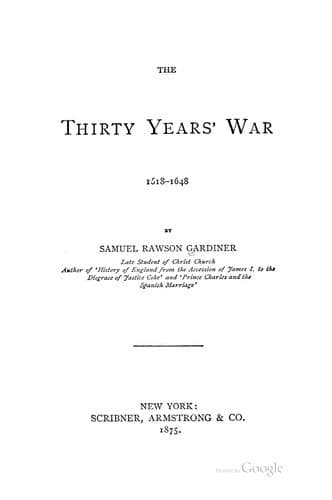
The Thirty Years' War, 1618-1648Gardiner, Samuel Rawson
History
The Thirty Years' War, 1618-1648
Gardiner, Samuel Rawson
Thirty Years' War, 1618-1648
He was no more successful with the citizens of Nüremberg than with the
Elector of Saxony. They replied that a matter of such importance should
be treated in common by all the cities and princes interested. "In that
case," he replied, bitterly, "the Elector of Saxony will dispute for
half a year in whose name the summons to the meeting ought to be issued.
When the cities, too, send deputies, they usually separate as they meet,
discovering that there is a defect in their instructions, and so refer
everything home again for further consideration, without coming to any
conclusion whatever." Can it be doubted that the political incompetence
of the Germans, caused by their internal divisions and their long disuse
of such institutions as would have enabled them to act in common, was a
thorn in the side of Gustavus, felt by him more deeply than the
appearance in the field, however unexpected, of Wallenstein and his
army?
[Sidenote: § 3. Gustavus and Wallenstein at Nüremberg.]
That army, however, must be met. Wallenstein had 60,000 men with him;
Gustavus but a third of the number. The war had blazed up along the
Rhine from Alsace to Coblentz. Pappenheim was fighting there, and the
Spaniards had sent troops of their own, and had summoned the Duke of
Lorraine to their aid. By-and-by it was seen how rightly Gustavus had
judged that France could not afford to quarrel with him. Though he had
dashed aside Richelieu's favourite scheme of leaving the ecclesiastical
territories untouched, and had refused to single out the House of
Austria as the sole object of the war, Richelieu could not fail to
support him against Spanish troops. In a few weeks the danger in his
rear was at an end, and the scattered detachments of the Swedish army
were hurrying to join their king at Nüremberg.
[Sidenote: § 4. Wallenstein entrenches himself.]
Gustavus was now ready for a battle. But a battle he could not have.
Wallenstein fell back upon his old tactics of refusing battle, except
when he had a manifest superiority of numbers. He entrenched himself
near Fürth, to the north of Nüremberg, on a commanding eminence
overlooking the whole plain around. For twelve miles his works protected
his newly-levied army. House, villages, advantages of the ground were
everywhere utilized for defence.
[Sidenote: § 5. Wants of the Swedish army.]
In the meanwhile, scarcity and pestilence were doing their terrible work
at Nüremberg. The country people had flocked in for refuge, and the
population was too great to be easily supplied with food. Even in the
army want began to be felt. And with want came the relaxation of that
discipline upon which Gustavus prided himself. He had large numbers of
German troops in his army now, and a long evil experience had taught
Germans the habits of marauders.
[Sidenote: § 6. Gustavus remonstrates.]
Public-domain text, read in full here on John Shaqi.
Reviews
Reviews
No reviews yet
Be the first to share your thoughts on this work.
Elsewhere in the archive
Join the Discussion
Join the discussion
Sign in to leave a comment or review.
Sign InorCreate an account