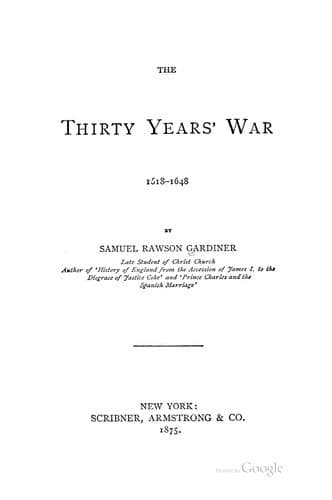
The Thirty Years' War, 1618-1648Gardiner, Samuel Rawson
History
The Thirty Years' War, 1618-1648
Gardiner, Samuel Rawson
Thirty Years' War, 1618-1648
The victories of mere force are never fruitful of good. As it had been
after the successes of Tilly in 1622, and the successes of Wallenstein
in 1626 and 1627, so it was now with the successes of the King of
Hungary in 1634 and 1635. The imperialist armies had gained victories,
and had taken cities. But the Emperor was none the nearer to the
confidence of Germans. An alienated people, crushed by military force,
served merely as a bait to tempt foreign aggression, and to make the way
easy before it. After 1622, the King of Denmark had been called in.
After 1627, an appeal was made to the King of Sweden. After 1634,
Richelieu found his opportunity. The bonds between France and the
mutilated League of Heilbronn were drawn more closely. German troops
were to be taken into French pay, and the empty coffers of the League
were filled with French livres. He who holds the purse holds the
sceptre, and the princes of Southern and Western Germany, whether they
wished it or not, were reduced to the position of satellites revolving
round the central orb at Paris.
[Sidenote: § 5. The Peace of Prague.]
Nowhere was the disgrace of submitting to French intervention felt so
deeply as at Dresden. The battle of Nördlingen had cut short any hopes
which John George might have entertained of obtaining that which
Wallenstein would willingly have granted him. But, on the other hand,
Ferdinand had learned something from experience. He would allow the
Edict of Restitution to fall, though he was resolved not to make the
sacrifice in so many words. But he refused to replace the Empire in the
condition in which it had been before the war. The year 1627 was to be
chosen as the starting point for the new arrangement. The greater part
of the northern bishoprics would thus be saved to Protestantism. But
Halberstadt would remain in the hands of a Catholic bishop, and the
Palatinate would be lost to Protestantism for ever. Lusatia, which had
been held in the hands of the Elector of Saxony for his expenses in the
war of 1620, was to be ceded to him permanently, and Protestantism in
Silesia was to be placed under the guarantee of the Emperor. Finally,
Lutheranism alone was still reckoned as the privileged religion, so that
Hesse Cassel and the other Calvinist states gained no security at all.
On May 30, 1635, a treaty embodying these arrangements was signed at
Prague by the representatives of the Emperor and the Elector of Saxony.
It was intended not to be a separate treaty, but to be the starting
point of a general pacification. Most of the princes and towns so
accepted it, after more or less delay, and acknowledged the supremacy of
the Emperor on its conditions. Yet it was not in the nature of things
that it should put an end to the war. It was not an agreement which any
one was likely to be enthusiastic about. The ties which bound Ferdinand
to his Protestant subjects had been rudely broken, and the solemn
promise to forget and forgive could not weld the nation into that unity
Public-domain text, read in full here on John Shaqi.
Reviews
Reviews
No reviews yet
Be the first to share your thoughts on this work.
Elsewhere in the archive
Join the Discussion
Join the discussion
Sign in to leave a comment or review.
Sign InorCreate an account