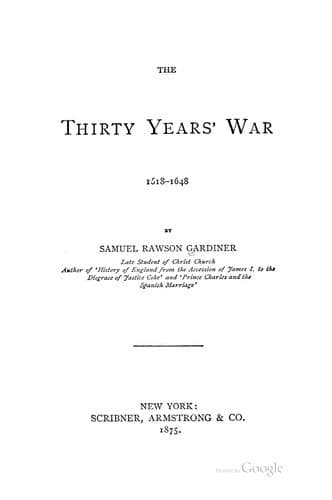
The Thirty Years' War, 1618-1648Gardiner, Samuel Rawson
History
The Thirty Years' War, 1618-1648
Gardiner, Samuel Rawson
Thirty Years' War, 1618-1648
Unlike Lewis XIV. and Napoleon, Richelieu counts amongst those few
French statesmen whose fortune mounted with their lives. It is not
difficult to discover the cause. As in Gustavus, love of action was
tempered by extreme prudence and caution. But in Richelieu these
ingredients of character were mingled in different proportions. The love
of action was far less impetuous. The caution was far stronger. No man
had a keener eye to distinguish the conditions of success, or was more
ready to throw aside the dearest schemes when he believed them to be
accompanied by insuperable difficulties. Braver heart never was. There
was the highest courage in the constancy with which he, an invalid
tottering for years on the brink of the grave, and supported by a king
whose health was as feeble as his own, faced the whole might of the
aristocracy of France. If he was harsh and unpitying it was to the
enemies of the nation, to the nobles who trod under their feet the
peasant and the serf, and who counted the possession of power merely as
the high-road to the advancement of their private fortunes. The
establishment of a strong monarchical power was, as France was then
constituted, the only chance for industry and commerce to lift up their
heads, for the peaceable arts of life to develop themselves in security,
for the intellect of man to have free course, and for the poor to be
protected from oppression.
[Sidenote: § 2. His designs only partially accomplished.]
All this was in Richelieu's heart; and some little of this he
accomplished. The work of many generations was in this man's brain. Yet
he never attempted to do more than the work of his own. As Bacon
sketched out the lines within which science was to move in the days of
Newton and of Faraday, so Richelieu sketched out the lines within which
French statesmanship was to move in the days of Colbert and of Turgot,
or in those of the great Revolution itself.
[Sidenote: § 3. The people nothing in France.]
Public-domain text, read in full here on John Shaqi.
Reviews
Reviews
No reviews yet
Be the first to share your thoughts on this work.
Elsewhere in the archive
Join the Discussion
Join the discussion
Sign in to leave a comment or review.
Sign InorCreate an account