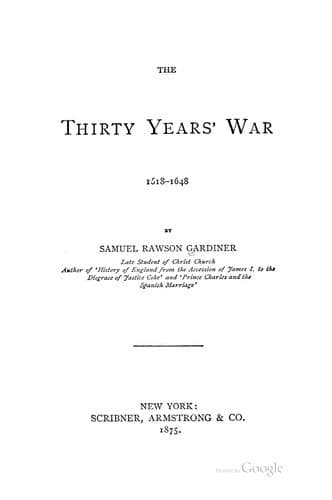
The Thirty Years' War, 1618-1648Gardiner, Samuel Rawson
History
The Thirty Years' War, 1618-1648
Gardiner, Samuel Rawson
Thirty Years' War, 1618-1648
"All things for the people, nothing by the people." This maxim
attributed to Napoleon embodied as well the policy of Richelieu. In it
are embalmed the strength and weakness of French statesmanship. The late
growth of the royal power and the long continuance of aristocratic
oppression threw the people helpless and speechless into the arms of the
monarchy. They were happy if some one should prove strong enough to take
up their cause without putting them to the trouble or the risk of
thinking and speaking for themselves. It is no blame to Richelieu if,
being a Frenchman of the seventeenth century, he worked under the only
conditions which Frenchmen of the seventeenth century would admit. We
can well fancy that he would think with scorn and contempt of the
English Revolution, which was accomplishing itself under his eyes. Yet
in the England of the Civil War, men were learning not merely to be
governed well, but to know what good government was. It was a greater
thing for a nation to learn to choose good and to refuse evil, even if
the progress was slow, than to be led blindfold with far more rapid
steps.
[Sidenote: § 4. His foreign policy.]
Richelieu's foreign policy was guided by the same deep calculation as
his home policy. If at home he saw that France was greater than any
faction, he had not arrived at the far higher notion that Europe was
greater than France, excepting so far as he saw in the system of
intolerance supported by Spain an evil to be combated for the sake of
others who were not Frenchmen. But there is no sign that he really cared
for the prosperity of other nations when it was not coincident with the
prosperity of France. As it is for the present generation a matter of
complete indifference whether Breisach was to be garrisoned by Frenchmen
or imperialists, it would be needless for us, if we regarded Richelieu's
motives alone, to trouble ourselves much with the later years of the
Thirty Years' War.
[Sidenote: § 5. His support of rising causes.]
But it is not always by purity of motive only that the world's progress
advances. Richelieu, in order to make France strong, needed help, and he
had to look about for help where the greatest amount of strength was to
be found. An ordinary man would have looked to the physical strength of
armies, as Wallenstein did, or to the ideal strength of established
institutions, as Ferdinand did. Richelieu knew better. He saw that for
him who knows how to use it there is no lever in the world like that of
a rising cause, for a rising cause embodies the growing dissatisfaction
of men with a long-established evil, which they have learned to detest,
but which they have not yet learned to overthrow.
[Sidenote: § 6. And of those causes which were in themselves good.]
Public-domain text, read in full here on John Shaqi.
Reviews
Reviews
No reviews yet
Be the first to share your thoughts on this work.
Elsewhere in the archive
Join the Discussion
Join the discussion
Sign in to leave a comment or review.
Sign InorCreate an account