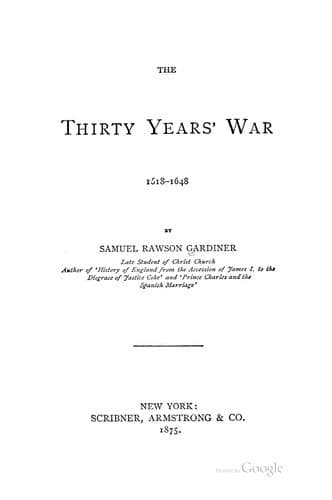
The Thirty Years' War, 1618-1648Gardiner, Samuel Rawson
History
The Thirty Years' War, 1618-1648
Gardiner, Samuel Rawson
Thirty Years' War, 1618-1648
And, if he was to fight at all, there could be no question on which side
he would be found. There was a certain heroism about him which made him
love to look upon himself as the champion of high causes and the
promoter of noble aims. To such an one it would seem to be altogether
debasing to hold his bishopric on the mere tenure of the agreement of
Mühlhausen, to be debarred from taking the place due to him in the Diet
of the Empire, and to be told that if he was very loyal and very
obedient to the Emperor, no force would be employed to wrest from him
that part of the property of the Church which he held through a system
of iniquitous robbery. Then, too, came a visit to the Hague, where the
bright eyes of his fair cousin the titular Queen of Bohemia chained him
for ever to her cause, a cause which might soon become his own. For who
could tell, when once the Palatinate was lost, whether the agreement of
Mühlhausen would be any longer regarded?
[Sidenote: § 13. His ravages in the diocese of Paderborn.]
In the summer of 1621 Christian levied a force with which he marched
into the Catholic bishopric of Paderborn. The country was in the course
of forcible conversion by its bishop, and there was still in it a strong
Lutheran element, which would perhaps have answered the appeal of a
leader who was less purely an adventurer. But except in word, Catholic
and Protestant were alike to Christian, so long as money could be got to
support his army. Castles, towns, farmhouses were ransacked for the
treasure of the rich, and the scanty hoard of the poor. We need not be
too hard on him if he tore down the silver shrine of a saint in
the cathedral of Paderborn, and melted it into coin bearing the
legend:--'The friend of God and the enemy of the priests.' But it is
impossible to forget he was the enemy of the peasants as well.
Burning-masters appear among the regular officers of his army; and many
a village, unable to satisfy his demands, went up in flames, with its
peaceful industry ruined for ever. At last, satiated with plunder, he
turned southward to the support of Mansfeld.
[Sidenote: § 14. Mansfeld will not make peace.]
Such were the commanders into whose hands the fortunes of German
Protestantism had fallen. Mansfeld told Vere plainly that whether there
were a truce or not, he at least would not lay down his arms unless he
were indemnified for his expenses by a slice out of the Austrian
possession of Alsace.
[Sidenote: § 15. Tilly in the midst of his enemies.]
Public-domain text, read in full here on John Shaqi.
Reviews
Reviews
No reviews yet
Be the first to share your thoughts on this work.
Join the Discussion
Join the discussion
Sign in to leave a comment or review.
Sign InorCreate an account