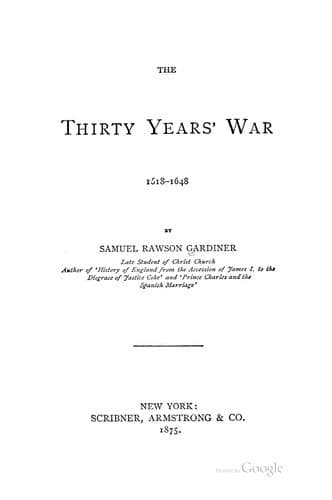
The Thirty Years' War, 1618-1648Gardiner, Samuel Rawson
History
The Thirty Years' War, 1618-1648
Gardiner, Samuel Rawson
Thirty Years' War, 1618-1648
Constitutional opposition on the part of the Protestants was impossible.
In addition to the majority against them amongst the princes, there was
now, by the mere fact of Frederick's exclusion, a majority against them
amongst the Electors, a majority which was all the more firmly
established when, on February 13, the transfer was solemnly declared.
Maximilian was to be Elector for his lifetime. If any of Frederick's
relations claimed that the electorate ought rather to pass over to them,
they would be heard, and if their case appeared to be a good one, they
would receive what was due to them after Maximilian's death. If, in the
meanwhile, Frederick chose to ask humbly for forgiveness, and to abandon
his claim to the electoral dignity, the Emperor would take his request
for the restitution of his lands into favourable consideration. Against
all this the Spanish ambassador protested; but the protest was evidently
not meant to be followed by action.
[Sidenote: § 4. The North German Protestants.]
The question of peace or war now depended mainly on the North German
Protestants. Nobody doubted that, if they could hit upon a united plan
of action, and if they vigorously set to work to carry it out, they
would bring an irresistible weight to bear upon the points at issue.
Unfortunately, however, such uniformity of action was of all things most
improbable. John George, indeed, had more than once been urged in
different directions during the past years by events as they
successively arose. The invasion of the Palatinate had shaken him in his
friendship for the Emperor. Then had come the kidnapping of the
Landgrave of Darmstadt to give him a shock on the other side. Later in
the year the news that an excuse had been found for driving the Lutheran
clergy out of Bohemia had deeply exasperated him, and his exasperation
had been increased by the transference of the electorate, by which the
Protestants were left in a hopeless minority in the Electoral House. But
the idea of making war upon the Emperor, and unsettling what yet
remained as a security for peace, was altogether so displeasing to John
George that it is doubtful whether anything short of absolute necessity
would have driven him to war. What he would have liked would have been a
solemn meeting, at which he might have had the opportunity of advancing
his views. But if those views had been seriously opposed he would hardly
have drawn the sword to uphold them.
[Sidenote: § 5. Mansfeld and Christian of Brunswick.]
Public-domain text, read in full here on John Shaqi.
Reviews
Reviews
No reviews yet
Be the first to share your thoughts on this work.
Join the Discussion
Join the discussion
Sign in to leave a comment or review.
Sign InorCreate an account