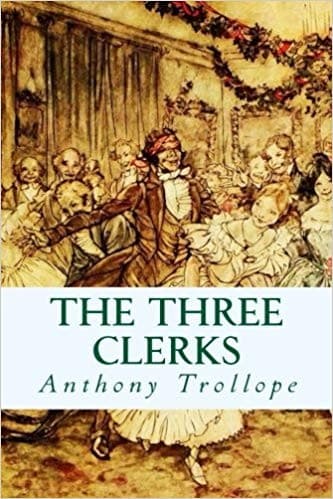
Civil service -- Fiction; London (England) -- Fiction
Nor would it have been fair to blame Gertrude in the matter. While she
was yet a child, this friend of her mother's had been thrown with her,
and when she was little more than a child, she found that this friend
had become a lover. She liked him, in one sense loved him, and was
accustomed to regard him as one whom it would be almost wrong in her not
to like and love. What wonder then that when he first spoke to her warm
words of adoration, she had not been able at once to know her own heart,
and tell him that his hopes would be in vain?
She perceived by instinct, rather than by spoken words, that her mother
was favourable to this young lover, that if she accepted him she would
please her mother, that the course of true love might in their case run
smooth. What wonder then that she should have hesitated before she found
it necessary to say that she could not, would not, be Harry Norman's
wife?
On the Saturday morning, the morning of that night which was, as he
hoped, to see him go to bed a happy lover, so happy in his love as to be
able to forget his other sorrows, she was sitting alone with her mother.
It was natural that their conversation should turn to Alaric and Harry.
Alaric, with his happy prospects, was soon dismissed; but Mrs. Woodward
continued to sing the praises of him who, had she been potent with the
magi of the Civil Service, would now be the lion of the Weights and
Measures.
'I must say I think it was weak of him to retire,' said Gertrude.
'Alaric says in his letter to Uncle Bat, that had he persevered he would
in all probability have been successful.'
'I should rather say that it was generous,' said her mother.
'Well, I don't know, mamma; that of course depends on his motives;
but wouldn't generosity of that sort between two young men in such a
position be absurd?'
'You mean that such regard for his friend would be Quixotic.'
'Yes, mamma.'
'Perhaps it would. All true generosity, all noble feeling, is now called
Quixotic. But surely, Gertrude, you and I should not quarrel with Harry
on that account.'
'I think he got frightened, mamma, and had not nerve to go through with
it.'
Mrs. Woodward looked vexed; but she made no immediate reply, and for
some time the mother and daughter went on working without further
conversation. At last Gertrude said:--
'I think every man is bound to do the best he can for himself--that is,
honestly; there is something spoony in one man allowing another to get
before him, as long as he can manage to be first himself.'
Mrs. Woodward did not like the tone in which her daughter spoke. She
felt that it boded ill for Harry's welfare; and she tried, but tried in
vain, to elicit from her daughter the expression of a kinder feeling.
'Well, my dear, I must say I think you are hard on him. But, probably,
just at present you have the spirit of contradiction in you. If I were
to begin to abuse him, perhaps I should get you to praise him.'
'Oh, mamma, I did not abuse him.'
Public-domain text, read in full here on John Shaqi.
Reviews
Reviews
No reviews yet
Be the first to share your thoughts on this work.
Elsewhere in the archive
Join the Discussion
Join the discussion
Sign in to leave a comment or review.
Sign InorCreate an account