Produced by Nick Hodson of London, England
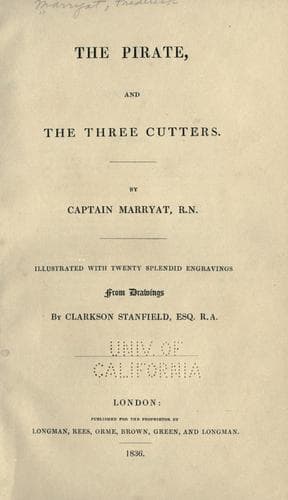
The Three Cutters, by Captain Marryat.
________________________________________________________________________
Captain Frederick Marryat was born July 10 1792, and died August 8 1848.
He retired from the British navy in 1828 in order to devote himself to
writing. In the following 20 years he wrote 26 books, many of which are
among the very best of English literature, and some of which are still
in print.
Marryat had an extraordinary gift for the invention of episodes in his
stories. He says somewhere that when he sat down for the day's work, he
never knew what he was going to write. He certainly was a literary
genius.
"The Three Cutters" was published in 1836, the tenth book to flow from
Marryat's pen.
This e-book was transcribed in 1998 by Nick Hodson, and was reformatted
in 2003, and again in 2005.
________________________________________________________________________
THE THREE CUTTERS, BY CAPTAIN FREDERICK MARRYAT.
CHAPTER ONE.
CUTTER THE FIRST.
Reader, have you ever been at Plymouth? If you have, your eye must have
dwelt with ecstasy upon the beautiful property of the Earl of Mount
Edgcumbe: if you have not been at Plymouth, the sooner that you go there
the better. At Mount Edgcumbe you will behold the finest timber in
existence, towering up to the summits of the hills, and feathering down
to the shingle on the beach. And from this lovely spot you will witness
one of the most splendid panoramas in the world. You will see--I hardly
know what you will not see--you will see Ram Head, and Cawsand Bay; and
then you will see the Breakwater, and Drake's Island, and the Devil's
Bridge below you; and the town of Plymouth and its fortifications, and
the Hoe; and then you will come to the Devil's Point, round which the
tide runs devilish strong; and then you will see the New Victualling
Office,--about which Sir James Gordon used to stump all day, and take a
pinch of snuff from every man who carried a box, which all were
delighted to give, and he was delighted to receive, proving how much
pleasure may be communicated merely by a pinch of snuff; and then you
will see Mount Wise and Mutton Cove; the town of Devonport; with its
magnificent dockyard and arsenals, North Corner, and the way which leads
to Saltash. And you will see ships building and ships in ordinary; and
ships repairing and ships fitting; and hulks and convict ships, and the
guard-ship; ships ready to sail and ships under sail; besides lighters,
men-of-war's boats, dockyard-boats, bum-boats, and shore-boats. In
short, there is a great deal to see at Plymouth besides the sea itself:
but what I particularly wish now is, that you will stand at the battery
of Mount Edgcumbe and look into Barn Pool below you, and there you will
see, lying at single anchor, a cutter; and you may also see, by her
pendant and ensign, that she is a yacht.
Public-domain text, read in full here on John Shaqi.
Reviews
Reviews
No reviews yet
Be the first to share your thoughts on this work.
Join the Discussion
Join the discussion
Sign in to leave a comment or review.
Sign InorCreate an account