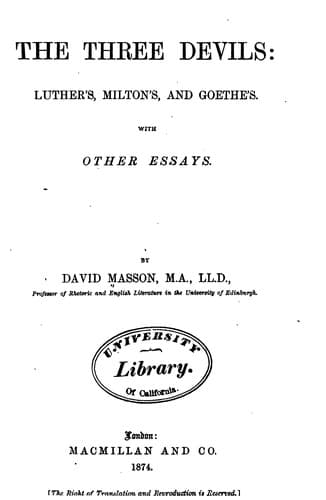
The Three Devils: Luther's, Milton's, and Goethe's; With Other EssaysMasson, David
History
The Three Devils: Luther's, Milton's, and Goethe's; With Other Essays
Masson, David
Devil in literature; Literature -- History and criticism
a conscious spirit of superiority that he confronted the generation of his
coevals and juniors, the natural subjects of his laureateship. If we set
aside such men as Locke and Barrow, belonging more to other departments
than to that of literature proper, there were none of these coevals or
juniors who were entitled to dispute his authority. There was the Duke of
Buckingham, a year or two older than Dryden, at once the greatest wit and
the greatest profligate about Charles's court, but whose attempts in the
comic drama were little more than occasional eccentricities. There were
the Earls of Dorset and Roscommon, both about Dryden's age, and both
cultivated men and respectable versifiers. There was Thomas Sprat,
afterwards Bishop of Rochester, and now chaplain to his grace of
Buckingham, five years younger than Dryden, his fellow-member in the Royal
Society, and with considerable pretensions to literary excellence. There
was the witty rake, Sir Charles Sedley, a man of frolic, like Buckingham,
some seven years Dryden's junior, and the author of at least three
comedies and three tragedies. There was the still more witty rake, Sir
George Etherege, of about the same age, the author of two comedies,
produced between 1660 and 1670, which, for ease and sprightly fluency,
surpassed anything that Dryden had done in the comic style. But "gentle
George," as he was called, was incorrigibly lazy; and it did not seem as
if the public would get anything more from him. In his place had come
another gentleman-writer, young William Wycherley, whose first comedy had
been written before Dryden's laureateship, though it was not acted till
1672, and who was already famous as a wit. Of precisely the same age as
Wycherley, and with a far greater _quantity_ of comic writing in him,
whatever might be thought of the quality, was Thomas Shadwell, whose bulky
body was a perpetual source of jest against him, though he himself vaunted
it as one of his many resemblances to Ben Jonson. The contemporary opinion
of these two last-named comic poets, Wycherley and Shadwell, after they
came to be better known, is expressed in these lines from a poem of
Rochester's:--
"Of all our modern wits none seem to me
Once to have touched upon true comedy
But hasty Shadwell and slow Wycherley.
Shadwell's unfinished works do yet impart
Great proofs of force of Nature, none of Art.
With just bold strokes he dashes here and there,
Showing great mastery with little care;
Scorning to varnish his good touches o'er,
To make the fools and women praise the more.
But Wycherley earns hard whate'er he gains;
He wants no judgment, and he spares no pains;
He frequently excels, and, at the least,
Makes fewer faults than any of the rest."
Public-domain text, read in full here on John Shaqi.
Reviews
Reviews
No reviews yet
Be the first to share your thoughts on this work.
Elsewhere in the archive
Join the Discussion
Join the discussion
Sign in to leave a comment or review.
Sign InorCreate an account