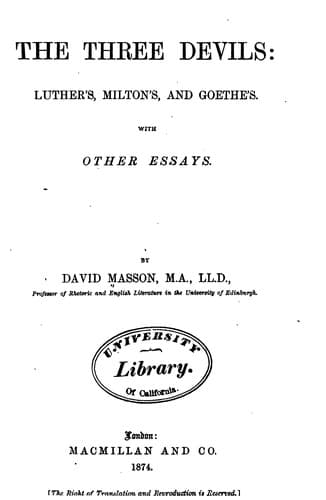
The Three Devils: Luther's, Milton's, and Goethe's; With Other EssaysMasson, David
History
The Three Devils: Luther's, Milton's, and Goethe's; With Other Essays
Masson, David
Devil in literature; Literature -- History and criticism
"Dame Fortune, some men's titular,
Takes charge of them without their care,
Does all their drudgery and work,
Like fairies, for them in the dark;
Conducts them blindfold, and advances
The naturals by blinder chances;
While others by desert and wit
Could never make the matter hit,
But still, the better they deserve,
Are but the abler thought to starve."
Dryden, at the time of his appointment to the laureateship, was in his
fortieth year. This is worth noting, if we would realize his position
among his literary contemporaries. Of those contemporaries there were some
who, as being his seniors, would feel themselves free from all obligations
to pay him respect. To octogenarians like Hobbes and Izaak Walton he was
but a boy; and even from Waller, Milton, Butler, and Marvel, all of whom
lived to see him in the laureate's chair, he could only look for that
approving recognition, totally distinct from reverence, which men of
sixty-five, sixty, and fifty-five, bestow on their full-grown juniors.
Such an amount of recognition he seems to have received from all of them.
Butler, indeed, does not seem to have taken very kindly to him; and it
stands on record, as Milton's opinion of Dryden's powers about this
period, that he thought him "a rhymer but no poet." But Butler, who went
about snarling at most things, and was irreverent enough to think the
Royal Society itself little better than a humbug, was not the man from
whom a laudatory estimate of anybody was to be expected; and, though
Milton's criticism is too precious to be thrown away, and will even be
found on investigation to be not so far amiss, if the moment at which it
was given is duly borne in mind, yet it is, after all, not Milton's
opinion of Dryden's general literary capacity, but only his opinion of
Dryden's claims to be called a poet. Dryden, on his part, to whose charge
any want of veneration for his great literary predecessors cannot be
imputed, and whose faculty of appreciating the most various kinds of
excellence was conspicuously large, would probably have been more grieved
than indignant at this indifference of men like Butler and Milton to his
rising fame. He had an unfeigned admiration for the author of _Hudibras_;
and there was not a man in England who more profoundly revered the poet of
_Paradise Lost_, or more dutifully testified this reverence both by acts
of personal attention and by written expressions of allegiance to him
while he was yet alive. It would have pained Dryden much, we believe, to
know that the great Puritan poet, whom he made it a point of duty to go
and see now and then in his solitude, and of whom he is reported to have
said, on reading the _Paradise Lost_, "This man cuts us all out, and the
ancients too," thought no better of him than that he was a rhymer. But,
however he may have felt himself related to those seniors who were
vanishing from the stage, or whose literary era was in the past, it was in
Public-domain text, read in full here on John Shaqi.
Reviews
Reviews
No reviews yet
Be the first to share your thoughts on this work.
Elsewhere in the archive
Join the Discussion
Join the discussion
Sign in to leave a comment or review.
Sign InorCreate an account