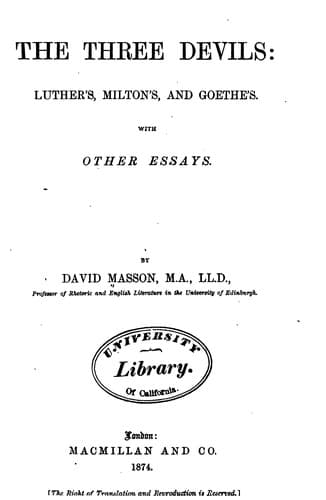
The Three Devils: Luther's, Milton's, and Goethe's; With Other EssaysMasson, David
History
The Three Devils: Luther's, Milton's, and Goethe's; With Other Essays
Masson, David
Devil in literature; Literature -- History and criticism
The tragedy of _All for Love_, which followed _Aurung-Zebe_, in 1678, and
in which he falls back on blank verse, is pronounced by many critics to be
the very best of all his dramas; and perhaps none of his plays has been
more read than the _Spanish Friar_, written in 1680. Yet it may be doubted
if in any of these plays Dryden achieved a degree of immediate success
equal to that which had attended his _Tyrannic Love_ and his _Conquest of
Granada_, written before his laureateship. This was not owing so much to
the single blow struck at his fame by Buckingham's _Rehearsal_ as to the
growth of that general spirit of criticism and disaffection which pursues
every author after the public have become sufficiently acquainted with his
style to expect the good, and look rather for the bad, in what he writes.
Thus, we find one critic of the day, Martin Clifford, who was a man of
some note, addressing Dryden, a year or two after his laureateship, in
this polite fashion: "You do live in as much ignorance and darkness as you
did in the womb; your writings are like a Jack-of-all-trades' shop; they
have a variety, but nothing of value; and, if thou art not the dullest
plant-animal that ever the earth produced, all that I have conversed with
are strangely mistaken in thee." This onslaught of Mr. Clifford's is
clearly to be regarded as only that gentleman's; but what young Rochester
said and thought about Dryden at this time is more likely to have been
what was said and thought generally by the critical part of the town.
"Well sir, 'tis granted: I said Dryden's rhymes
Were stolen, unequal--nay, dull, many times.
What foolish patron is there found of his
So blindly partial to deny me this?
But that his plays, embroidered up and down
With wit and learning, justly pleased the town,
In the same paper I as freely own.
Yet, having this allowed, the heavy mass
That stuffs up his loose volumes must not pass.
* * * * *
But, to be just, 'twill to his praise be found
His excellencies more than faults abound;
Nor dare I from his sacred temples tear
The laurel which he best deserves to wear.
* * * * *
And may I not have leave impartially
To search and censure Dryden's works, and try
If these gross faults his choice pen doth commit
Proceed from want of judgment or of wit,
Or if his lumpish fancy doth refuse
Spirit and grace to his loose slattern muse?"
Public-domain text, read in full here on John Shaqi.
Reviews
Reviews
No reviews yet
Be the first to share your thoughts on this work.
Elsewhere in the archive
Join the Discussion
Join the discussion
Sign in to leave a comment or review.
Sign InorCreate an account