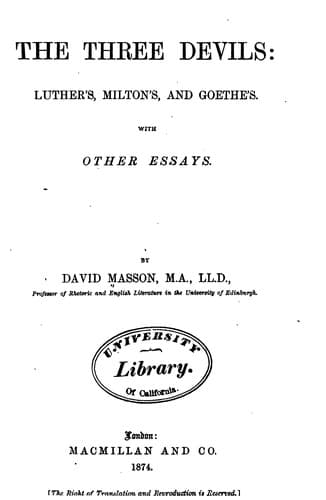
The Three Devils: Luther's, Milton's, and Goethe's; With Other EssaysMasson, David
History
The Three Devils: Luther's, Milton's, and Goethe's; With Other Essays
Masson, David
Devil in literature; Literature -- History and criticism
We have no doubt the opinion thus expressed by the scapegrace young earl
was very general. Dryden's own prose disquisitions on the principles of
poetry may have helped to diffuse many of those notions of genuine
poetical merit by which he was now tried. But, undoubtedly, what most of
all tended to expose Dryden's reputation to the perils of criticism was
the increasing number of his dramatic competitors and the evident ability
of some of them. True, most of those competitors were Dryden's personal
friends, and some of the younger of them, as Lee, Shadwell, Crowne, and
Tate, were in the habit of coming to him for prologues and epilogues, with
which to increase the attractions of their plays. On more than one
occasion, too, Dryden clubbed with Lee or Shadwell in the composition of a
dramatic piece. But, though thus on a friendly footing with most of his
contemporary dramatists, and almost in a fatherly relation to some of
them, Dryden found his popularity not the less affected by their
competition. In the department of prose comedy, Etherege, whose last and
best comedy, _Sir Fopling Flutter_, was produced in 1676, and Wycherley,
whose four celebrated comedies were all produced between 1672 and 1677,
had introduced a style compared with which Dryden's best comic attempts
were but heavy horse-play. Even the hulking Shadwell, who dashed off his
comedies as fast as he could write, had a vein of coarse natural humour
which Dryden lacked. It was in vain that Dryden tried to keep his
pre-eminence against these rivals by increased strength of language,
increased intricacy of plot, and an increased use of those indecencies
upon which they all relied so much in their efforts to please. One comedy
in which Dryden, trusting too confidently to this last element of success,
pushed grossness to the utmost conceivable limit, was hissed off the
stage. In tragedy, it is true, his position was more firm. But even in
this department some niches were cut in the body of his fame. His friend
Nat. Lee had produced one or two tragedies displaying a tenderness and a
wild force of passion to which Dryden's more masculine genius could not
pretend; Crowne had also done one or two things of a superior character;
and, though it was not till 1682 that Otway produced his _Venice
Preserved_, he had already given evidence of his mastery of dramatic
pathos. All this Dryden might have seen without allowing himself to be
much disturbed, conscious as he must have been that in general strength he
was still superior to all about him, however they might rival him in
particulars. The deliberate resolution, however, of Rochester and some
other aristocratic leaders of the fashion to make good their criticisms on
his writings, by setting up first one and then another of the dramatists
of the day as patterns of a higher style of art than his, provoked him out
of his composure. To show what he could do, if called upon to defend his
Public-domain text, read in full here on John Shaqi.
Reviews
Reviews
No reviews yet
Be the first to share your thoughts on this work.
Elsewhere in the archive
Join the Discussion
Join the discussion
Sign in to leave a comment or review.
Sign InorCreate an account