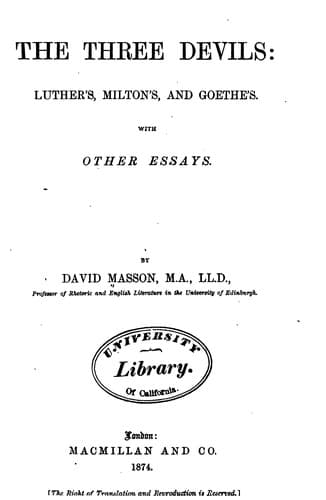
The Three Devils: Luther's, Milton's, and Goethe's; With Other EssaysMasson, David
History
The Three Devils: Luther's, Milton's, and Goethe's; With Other Essays
Masson, David
Devil in literature; Literature -- History and criticism
Thomas Southerne had begun his prolific career as a dramatist
in 1682, when Dryden furnished him with a prologue to his first play; but,
though after the Revolution he made more money by his dramas than ever
Dryden had made by his, he was ashamed to admit the fact to Dryden
himself. Matthew Prior, twenty-four years of age at the Revolution, had
made his first literary appearance before it, in no less important a
character than that of one of Dryden's political antagonists; but, though
_The Town and Country Mouse_ had been a decided hit, and Dryden himself
was said to have winced under it, no one pretended that the author was
anything more than a clever young man who had sat in Dryden's company and
turned his opportunities to account. Five years after the Revolution,
Congreve produced his first comedy at the age of twenty-four; but it was
Congreve's greatest boast in after life that that comedy had won him the
warm praises of Dryden, and laid the foundation of the extraordinary
friendship which subsisted between them during Dryden's last years, when
they used to walk together and dine together as father and son. During
these last years Dryden, had he been willing to see merit in any other
comedies than those of his young friend Congreve, might have hailed his
equal in Vanbrugh, and his superior in Farquhar, then beginning to write
for the stage. Among their coevals, destined to some distinction, he might
have marked Colley Cibber, Nicholas Rowe, and John Philips, the pleasing
parodist of Milton. Of the epics of Blackmore he had quite enough, at
least three of those performances having been given to the world before
Dryden died. At the time of Dryden's death his kinsman, Jonathan Swift,
was thirty-three years of age; Richard Steele was thirty; Daniel Defoe was
thirty; Addison was twenty-nine; Shaftesbury, the essayist, was
twenty-nine; Bolingbroke was twenty-two; and Parnell, the poet,
twenty-one. With these men a new literary movement was to take its origin;
but they had hardly yet begun their work; and there was not one of them,
Swift excepted, that would not, in the height of his subsequent fame, have
been proud to acknowledge his obligations to Dryden. Alexander Pope, the
next Englishman that was to take a place in general literature as high as
that occupied by Dryden, had been born only in the year of the Revolution,
and was consequently but a precocious boy of thirteen when Dryden left the
scene. _Virgilium tantum vidit_, as he used himself to say.
Public-domain text, read in full here on John Shaqi.
Reviews
Reviews
No reviews yet
Be the first to share your thoughts on this work.
Elsewhere in the archive
Join the Discussion
Join the discussion
Sign in to leave a comment or review.
Sign InorCreate an account