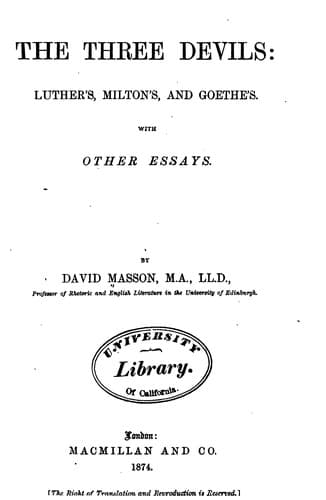
The Three Devils: Luther's, Milton's, and Goethe's; With Other EssaysMasson, David
History
The Three Devils: Luther's, Milton's, and Goethe's; With Other Essays
Masson, David
Devil in literature; Literature -- History and criticism
the birth of James's son, afterwards the Pretender, he made himself the
spokesman of the exulting Catholics, and published his _Britannia
Rediviva_.
"See how the venerable infant lies
In early pomp; how through the mother's eyes
The father's soul, with an undaunted view,
Looks out, and takes our homage as his due.
See on his future subjects how he smiles,
Nor meanly flatters, nor with craft beguiles;
But with an open face, as on his throne,
Assures our birthrights, and secures his own."
Within a few months after these lines were written, the father, the
mother, and the baby, were out of England, Dutch William was king, and the
Whigs had it all to themselves. Dryden, of course, had to give up the
laureateship; and, as William had but a small choice of poets, Shadwell
was put in his place.
The concluding period of Dryden's career, extending from the Revolution to
his death in 1701, exhibits him as a Tory patriarch lingering in the midst
of a Whig generation, and still, despite the change of dynasty, retaining
his literary pre-eminence. For a while, of course, he was under a cloud;
but after it had passed away he was at liberty to make his own terms with
the public. The country could have no literature except what he and such
as he chose to furnish. Locke, Sir William Temple, and others, indeed,
were now in a position to bring forward speculations smothered during the
previous reigns, and to scatter seeds that might spring up in new
literary forms. Burnet, Tillotson, and others might represent Whiggism in
the Church. But all the especially literary men whose services were
available at the beginning of the new reign were men who, whatever might
be their voluntary relations to the new order of things, had been more or
less trained in the school of the Restoration, and accustomed to the
supremacy of Dryden. The Earl of Rochester, the Earl of Roscommon, the
Duke of Buckingham, Etherege, and poor Otway, were dead; but Shadwell,
Settle, Lee, Crowne, Tate, Wycherley, the Earl of Dorset, Tom D'Urfey, and
Sir Charles Sedley, were still alive. Shadwell, coarse and fat as ever,
enjoyed the laureateship till his death in 1692, when Nahum Tate was
appointed to succeed him. Settle had degenerated in the City showman. Lee,
liberated from Bedlam, continued to write tragedies till April 1692, when
he tumbled over a bulk going home drunk at night through Clare Market, and
was killed or stifled among the snow. "Little starched Johnny Crowne" kept
up the respectability of his character. Wycherley lived as a man of
fashion about town, and wrote no more. Sedley and the Earl of Dorset were
also idle; and Tom D'Urfey made small witticisms, and called them "pills
to purge melancholy." Among such men Dryden, so long as he cared to be
seen among them, held necessarily his old place. Nor were there any of
the younger men, as yet known, in whom the critics recognised, or who
recognised in themselves, any title to renounce allegiance to the
ex-laureate.
Public-domain text, read in full here on John Shaqi.
Reviews
Reviews
No reviews yet
Be the first to share your thoughts on this work.
Elsewhere in the archive
Join the Discussion
Join the discussion
Sign in to leave a comment or review.
Sign InorCreate an account