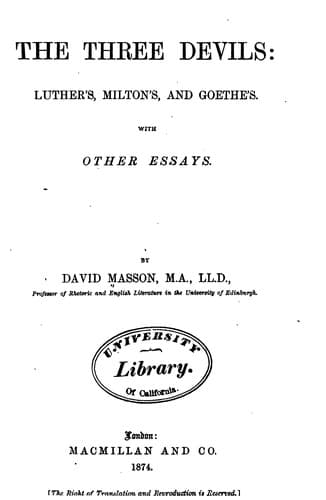
The Three Devils: Luther's, Milton's, and Goethe's; With Other EssaysMasson, David
History
The Three Devils: Luther's, Milton's, and Goethe's; With Other Essays
Masson, David
Devil in literature; Literature -- History and criticism
Those of Dryden's writings which were produced during the twelve years of
his life subsequent to the Revolution constitute an important part of his
literary remains, not merely in point of bulk, but also in respect of a
certain general peculiarity of their character. They may be described as
for the most part belonging to the department of pure, as distinct from
that of controversial, literature. Dryden did not indeed wholly abandon
satire and controversy after the Revolution; but his aim after that period
seemed rather to be to produce such literature as would at once be
acceptable to the public and earn for himself most money with the least
trouble. Deprived of his laureateship, and so rendered almost entirely
dependent on his pen at a time when age was creeping upon him and the
expenses of his family were greater than ever, he was obliged to make
considerations of economy paramount in his choice of work. As was natural,
he fell back at first on the drama; and his five last plays, two of which
are tragedies, one an opera, and two comedies, were all produced between
1689 and 1694. The profits of these dramas, however, were insufficient;
and he was obliged to eke them out by all those devices of dedication to
private noblemen, execution of literary commissions for elegiac poems, and
the like, which then formed part of the professional author's means of
livelihood. Sums of 50_l._, 100_l._, and even, in one or two cases,
500_l._, were earned by Dryden in this disagreeable way from earls,
squires, and clubs of gentlemen. His poem of _Eleonora_ was a 500_l._
commission, executed for the Earl of Abingdon, who wanted a poem in memory
of his deceased wife, and, without knowing anything of Dryden personally,
applied to him to write it, just as now, in a similar case, a commission
might be given to a popular sculptor for a _post mortem_ statue. In spite
of the utmost allowance for the custom of the time, no one knowing the
circumstances, can read the poem now, without disgust; and it does show a
certain lowness of mind in Dryden to have been able, under any pressure of
necessity, to write for hire such extravagances as that poem contains
respecting a person he had never seen. Far more honourable were Dryden's
earnings by work done for Jacob Tonson, the publisher. His dealings with
Tonson had begun before the Revolution; but after the Revolution Tonson
was his mainstay. First came several volumes of miscellanies, consisting
of select poems, published and unpublished, with scraps of prose and
translation. Then, catching at the hint furnished by the success of some
of the scraps of translation from the Latin and Greek poets, Dryden and
Tonson found it mutually advantageous to prosecute that vein. Juvenal and
Persius were translated under Dryden's care; and in 1697, after three
years of labour, he gave to the world his completed translation of
_Virgil_. Looking about for a task to succeed this, he undertook to
Public-domain text, read in full here on John Shaqi.
Reviews
Reviews
No reviews yet
Be the first to share your thoughts on this work.
Elsewhere in the archive
Join the Discussion
Join the discussion
Sign in to leave a comment or review.
Sign InorCreate an account