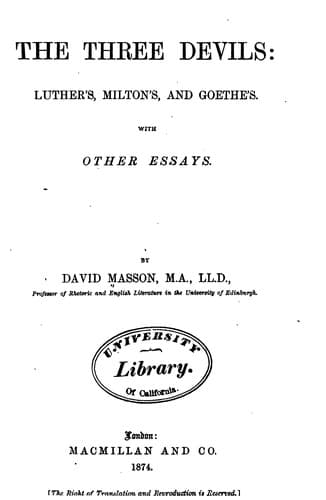
The Three Devils: Luther's, Milton's, and Goethe's; With Other EssaysMasson, David
History
The Three Devils: Luther's, Milton's, and Goethe's; With Other Essays
Masson, David
Devil in literature; Literature -- History and criticism
furnish Tonson with so many thousands of lines of narrative verse, to be
published under the title of _Fables_. Where the fables came from Tonson
did not care, provided they would sell; and Dryden, with his rapid powers
of versification, soon produced versions of some tales of Chaucer and
Boccaccio which answered the purpose exceedingly well. They were printed
in 1699. Of the other poems written by Dryden in his last years his
_Alexander's Feast_ is the most celebrated. He continued his literary
labours till within a few days of his death, which happened on the 1st of
May, 1701.
When we inquire what it is that makes Dryden's name so important as to
entitle it to rank, as it seems to do, the fifth in the series of great
English poets after Chaucer, Spenser, Shakespeare, and Milton, we find
that it is nothing else than the fact, brought out in the preceding
sketch, that, steadily and industriously, for a period of forty-two years,
he kept in the front of the national literature, such as it then was. It
is because he represents the entire literary development of the
Restoration--it is because he fills up the whole interval between 1658 and
1701, thus connecting the age of Puritanism and Milton with the age of the
Queen Anne wits--that we give him such a place in such a list. The reason
is a chronological one, rather than one of strict comparison of personal
merits. Though we place Dryden fifth in the list, after Chaucer, Spenser,
Shakespeare, and Milton, it is not necessarily because we regard him as
the co-equal of those men in genius; it is only because, passing onward in
time, we find his the next name of very distinguished magnitude after
theirs. Personally there is no one that would compare Dryden with
Shakespeare or Milton; and there are not many now that would compare him
with Chaucer or Spenser. On the whole, if the estimate is one of general
intellectual strength, he takes rank only with the first of the second
class, as with the Jonsons, the Fletchers, and others of the Elizabethan
age; while, if the estimate have regard to genuine poetic or imaginative
power, he sinks below even these. Yet, if historical reasons only are
regarded, Dryden has perhaps a better right to his place in the list than
any of the others. At least as strictly as Chaucer is the representative
of the English literature of the latter half of the fourteenth century,
far more strictly than Spenser and Shakespeare are the representatives of
the literature of their times, and in a more broad and obvious manner than
Milton is the literary representative of the Commonwealth, Dryden
represents the literary activity of the reigns of Charles II. and James
II., and of the greater part of that of William III. Davenant, Butler,
Waller, Etherege, Otway, Wycherley, Southerne, Prior, and Congreve, are
names leading us over the same period, and illustrating perhaps more
exquisitely than Dryden some of its individual characteristics; but for a
Public-domain text, read in full here on John Shaqi.
Reviews
Reviews
No reviews yet
Be the first to share your thoughts on this work.
Elsewhere in the archive
Join the Discussion
Join the discussion
Sign in to leave a comment or review.
Sign InorCreate an account