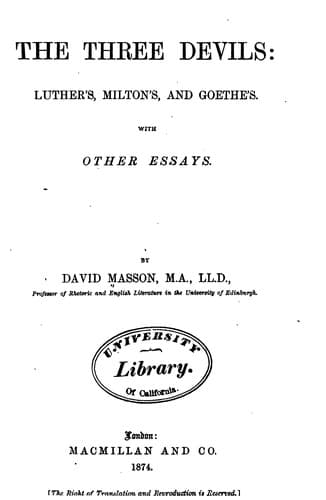
The Three Devils: Luther's, Milton's, and Goethe's; With Other EssaysMasson, David
History
The Three Devils: Luther's, Milton's, and Goethe's; With Other Essays
Masson, David
Devil in literature; Literature -- History and criticism
Whiggism or Toryism, in the social foibles and peculiarities of the day,
as we see in the _Tatler_ and the _Spectator_. Nor could a genial mind
like that of Steele, a man of taste and fine thought like Addison, and an
intellect so keen, exquisite, and sensitive as that of Pope, fail to
variegate and surround all the duller and harder literature thus called
into being with more lasting touches of the humorous, the fanciful, the
sweet, the impassioned, the meditative, and the ideal. Thus from one was
obtained the character of a _Sir Roger de Coverley_, from another a
_Vision of Mirza_, and from the third a _Windsor Forest_, an _Epistle of
Héloïse_, and much else that delights us still. After all, however, it
remains true that the period of English literature now in question,
whatever admirable characteristics it may possess, exhibits a remarkable
deficiency of what, with recollections of former periods to guide us in
our use of epithets, we should call great or sublime.
With the single exception of Pope, and that exception made from deference
to the peculiar position of Pope as the poet or metrical artist of his
day, the greatest name in the history of English literature during the
early part of last century is that of Swift. In certain fine and deep
qualities, Addison and Steele, and perhaps Farquhar, excelled him, just as
in the succeeding generation Goldsmith had a finer vein of genius than was
to be found in Johnson with all his massiveness; but in natural brawn and
strength, in original energy, force, and imperiousness of brain, he
excelled them all. It was about the year 1702, when he was already
thirty-five years of age, that this strangest specimen of an Irishman, or
of an Englishman born in Ireland, first attracted attention in London
literary circles. The scene of his first appearance was Button's
coffee-house: the witnesses were Addison, Ambrose Philips, and other wits
belonging to Addison's little senate, who used to assemble there.
Public-domain text, read in full here on John Shaqi.
Reviews
Reviews
No reviews yet
Be the first to share your thoughts on this work.
Elsewhere in the archive
Join the Discussion
Join the discussion
Sign in to leave a comment or review.
Sign InorCreate an account