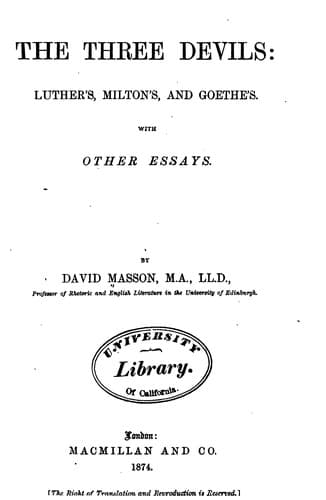
The Three Devils: Luther's, Milton's, and Goethe's; With Other EssaysMasson, David
History
The Three Devils: Luther's, Milton's, and Goethe's; With Other Essays
Masson, David
Devil in literature; Literature -- History and criticism
taking one side or the other in some current form of controversy has
afflicted the leading minds, and tormented the more genial among them; but
we question if ever in this country in previous times there was a form of
controversy, so little to be identified, in real reason, with the one only
true controversy between good and evil, and so capable, therefore, of
breeding confusion and mischief, when so identified in practice, as this
poor controversy of Whig and Tory which came in with the Revolution. To be
called upon to be either a Puritan or a Cavalier--there was some
possibility of complying with _that_ call and still leading a tolerably
free and large intellectual life; though possibly it was one, cause of the
rich mental development of the Elizabethan era that the men of that time
were exempt from any personal obligation of attending even to this
distinction. But to be called upon to be either a Whig or a Tory--why, how
on earth can one retain any of the larger humanities about him if society
is to hold him by the neck between two chairs such as these, pointing
alternately to the one and to the other, and incessantly asking him on
which of the two he means to sit? Into a mind trained to regard
adhesiveness to one or other of these chairs as the first rule of duty or
of prudence what thoughts of any high interest can find their way? Or, if
any such do find their way, how are they to be adjusted to so mean a rule?
Now-a-days, our higher spirits solve the difficulty by kicking both chairs
down, and plainly telling society that they will not bind themselves to
sit on either, or even on both put together. Hence partly it is that, in
recent times, we have had renewed specimens of the "great" or "sublime" in
literature--the poetry, for example, of a Byron, a Wordsworth, or a
Tennyson. But in the interval between 1688 and 1727 there was not one wit
alive whom society let off from the necessity of being, and declaring
himself to be, either a Whig or a Tory. Constitutionally, and by
circumstances, Pope was the man who could have most easily obtained the
exemption; but even Pope professed himself a Tory. Addison and Steele were
Whigs. In short, every literary man was bound, by the strongest of all
motives, to keep in view, as a permanent fact qualifying his literary
undertakings, the distinction between Whiggism and Toryism, and to give to
at least a considerable part of his writings the character of pamphlets or
essays in the service of his party. To minister by the pen to the
occasions of Whiggism and Toryism was, therefore, the main business of the
wits both in prose and verse. Out of those occasions of ministration there
of course arose personal quarrels, and these furnished fresh opportunities
to the men of letters. Critics of previous writings could be satirized and
lampooned, and thus the circle of subjects was widened. Moreover, there
was abundant matter, capable of being treated consistently with either
Public-domain text, read in full here on John Shaqi.
Reviews
Reviews
No reviews yet
Be the first to share your thoughts on this work.
Elsewhere in the archive
Join the Discussion
Join the discussion
Sign in to leave a comment or review.
Sign InorCreate an account