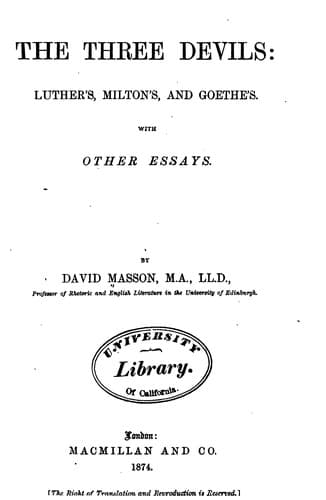
The Three Devils: Luther's, Milton's, and Goethe's; With Other EssaysMasson, David
History
The Three Devils: Luther's, Milton's, and Goethe's; With Other Essays
Masson, David
Devil in literature; Literature -- History and criticism
If the company present had had sufficient means of information, they would
have found that the mad parson with the harsh, swarthy features, and eyes
"azure as the heavens," whose oddities thus amused them, was Jonathan
Swift, then clergyman of Laracor, a rural parish in the diocese of Meath
in Ireland. They would have found that he was an Irishman by birth, though
of pure English descent; that he could trace a relationship to Dryden;
that, having been born after his father's death, he had been educated, at
the expense of his relatives, at Trinity College, Dublin; that, leaving
Ireland in his twenty-second year, with but a sorry character from the
College authorities, he had been received as a humble dependent into the
family of Sir William Temple, at Sheen and Moorpark, near London, that
courtly Whig and ex-ambassador being distantly connected with his mother's
family; that here, while acting as Sir William's secretary, amanuensis,
librarian, and what not, he had begun to write verses and other trifles,
some of which he had shown to Dryden, who had told him in reply that they
were sad stuff, and that he would never be a poet; that still, being of a
restless, ambitious temper, he had not given up hopes of obtaining
introduction into public employment in England through Sir William
Temple's influence; that, at length, at the age of twenty-eight,
despairing of anything better, he had quarrelled with Sir William,
returned to Ireland, taken priest's orders, and settled in a living; and
that again, disgusted with Ireland and his prospects in that country, he
had come back to Moorpark, and resided there till 1699, when Sir
William's death had obliged him finally to return to Ireland, and accept
first a chaplaincy to Lord Justice Berkeley, and then his present living
in the diocese of Meath. If curious about the personal habits of this
restless Irish parson, they might have found that he had already won the
reputation of an eccentric in his own parish and district: performing his
parochial duties when at home with scrupulous care, yet by his language
and manners often shocking all ideas of clerical decorum and begetting a
doubt as to his sincerity in the religion he professed; boisterous,
fierce, overbearing, and insulting to all about him, yet often doing acts
of real kindness; exact and economical in his management of his income to
the verge of actual parsimony, yet sometimes spending money freely, and
never without pensioners living on his bounty. They would have found that
he was habitually irritable, and that he was subject to a recurring
giddiness of the head, or vertigo, which he had brought on, as he thought
himself, by a surfeit of fruit while he was staying with Sir William
Temple at Sheen. And, what might have been the best bit of gossip of all,
they would have found that, though unmarried, and entertaining a most
unaccountable and violent aversion to the very idea of marriage, he had
Public-domain text, read in full here on John Shaqi.
Reviews
Reviews
No reviews yet
Be the first to share your thoughts on this work.
Elsewhere in the archive
Join the Discussion
Join the discussion
Sign in to leave a comment or review.
Sign InorCreate an account