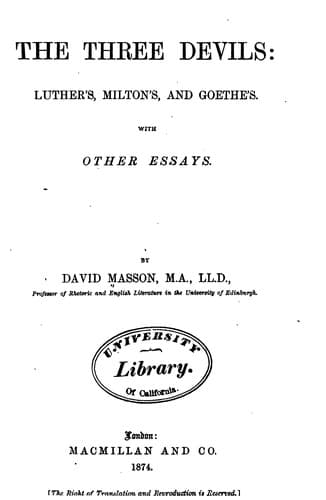
The Three Devils: Luther's, Milton's, and Goethe's; With Other EssaysMasson, David
History
The Three Devils: Luther's, Milton's, and Goethe's; With Other Essays
Masson, David
Devil in literature; Literature -- History and criticism
taken over to reside with him, or close to his neighbourhood, in Ireland,
a certain young and beautiful girl, named Hester Johnson, with whom he had
formed an acquaintance in Sir William Temple's house, where she had been
brought up, and where, though she passed as a daughter of Sir William's
steward, she was believed to be, in reality, a natural daughter of Sir
William himself. They would have found that his relations to this girl,
whom he had himself educated from her childhood at Sheen and Moorpark,
were of a very singular and puzzling kind; that on the one hand she was
devotedly attached to him, and on the other he cherished a passionate
affection for her, wrote and spoke of her as his "Stella," and liked
always to have her near him; yet that a marriage between them seemed not
to be thought of by either; and that, in order to have her near him
without giving rise to scandal, he had taken the precaution to bring over
an elderly maiden lady, called Mrs. Dingley, to reside with her as a
companion, and was most careful to be in her society only when this Mrs.
Dingley was present.
There was mystery and romance enough, therefore, about the wild,
black-browed Irish parson, who attracted the regards of the wits in
Button's coffee-house. What had brought him there? That was partly a
mystery too; but the mystery would have been pretty well solved if it had
been known that, uncouth-looking clerical lout as he was, he was an author
like the rest of them, having just written a political pamphlet which was
making or was to make a good deal of noise in the world, and having at
that moment in his pocket at least one other piece which he was about to
publish. The political pamphlet was an _Essay on the Civil Discords in
Athens and Rome_, having an obvious bearing on certain dissensions then
threatening to break up the Whig party in Great Britain. It was received
as a vigorous piece of writing on the ministerial side, and was ascribed
by some to Lord Somers, and by others to Burnet. Swift had come over to
claim it, and to see what it and his former connexion with Temple could do
for him among the leading Whigs. For the truth was, an ambition equal to
his consciousness of power gnawed at the heart of this furious and gifted
man, whom a perverse fate had flung away into an obscure vicarage on the
wrong side of the channel. His books, his garden, his canal with its
willows at Laracor; his dearly-beloved Roger Coxe, and the other perplexed
and admiring parishioners of Laracor over whom he domineered; his clerical
colleagues in the neighbourhood; and even the society of Stella, the
wittiest and best of her sex, whom he loved better than any other creature
on earth: all these were insufficient to occupy the craving void in his
mind. He hated Ireland, and regarded his lot there as one of banishment;
he longed to be in London, and struggling in the centre of whatever was
going on. About the date of his appointment to the living of Laracor he
Public-domain text, read in full here on John Shaqi.
Reviews
Reviews
No reviews yet
Be the first to share your thoughts on this work.
Elsewhere in the archive
Join the Discussion
Join the discussion
Sign in to leave a comment or review.
Sign InorCreate an account