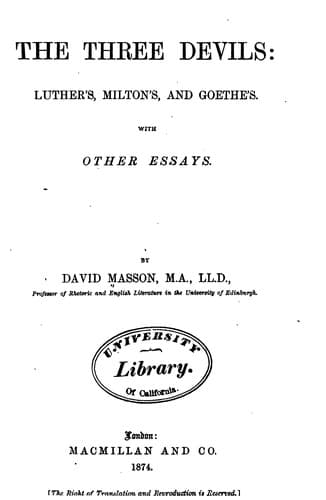
The Three Devils: Luther's, Milton's, and Goethe's; With Other EssaysMasson, David
History
The Three Devils: Luther's, Milton's, and Goethe's; With Other Essays
Masson, David
Devil in literature; Literature -- History and criticism
this perception of its uses as a vast administrative and educational
establishment we will not say. Mr. Thackeray, indeed, openly avows his
opinion that Swift had no belief in the Christian religion. "Swift's," he
says, "was a reverent, was a pious spirit--he could love and could pray;"
but such religion as he had, Mr. Thackeray hints, was a kind of mad,
despairing Deism, and had nothing of Christianity in it. Hence, "having
put that cassock on, it poisoned him; he was strangled in his bands." The
question thus broached as to the nature of Swift's religion is too deep to
be discussed here. Though we would not exactly say, with Mr. Thackeray,
that Swift's was a "reverent" and "pious" spirit, there are, as he phrases
it, breakings out of "the stars of religion and love" shining in the
serene blue through "the driving clouds and the maddened hurricane of
Swift's life;" and this, though vague, is about all that we have warrant
for saying. As to the zeal of his Churchmanship, however, there is no
doubt at all. There was not a man in the British realms more pugnacious in
the interests of his order, more resolute in defending the prerogatives of
the Church of England against Dissenters and others desirous of limiting
them, or more anxious to elevate the social position and intellectual
character of the clergy, than the author of the _Tale of a Tub_. No
veteran commander of a regiment could have had more of the military than
the parson of Laracor had of the ecclesiastical _esprit de corps_; and,
indeed, Swift's known dislike to the military may be best explained as the
natural jealousy of the surplice at the larger consideration accorded by
society to the scarlet coat. Almost all Swift's writings between 1702 and
1710 are assertions of his High-Church sentiments and vindications of the
Establishment against its assailants. Thus in 1708 came forth his _Letter
on the Sacramental Test_, a hot High-Church and anti-Dissenter pamphlet;
and this was followed in the same year by his _Sentiments of a Church of
England man with respect to Religion and Government_, and by his ironical
argument, aimed at free-thinkers and latitudinarians, entitled _Reasons
against Abolishing Christianity_. In 1709 he published a graver pamphlet,
under the name of _A Project for the Advancement of Religion_, in which he
urged certain measures for the reform of public morals and the
strengthening of the Establishment, recommending in particular a scheme of
Church-extension. Thus, with all his readiness to help the Whigs
politically, Swift was certainly faithful to his High-Church principles.
But, as we have said, a High-Church Whig was an anomaly which the Whigs
refused to comprehend. Latitudinarians, Low Churchmen, and Dissenters, did
not know what to make of a Whiggism in state-politics which was conjoined
with the strongest form of ecclesiastical Toryism. Hence, in spite of his
ability, Swift was not a man that the Whigs could patronise and prefer.
Public-domain text, read in full here on John Shaqi.
Reviews
Reviews
No reviews yet
Be the first to share your thoughts on this work.
Elsewhere in the archive
Join the Discussion
Join the discussion
Sign in to leave a comment or review.
Sign InorCreate an account