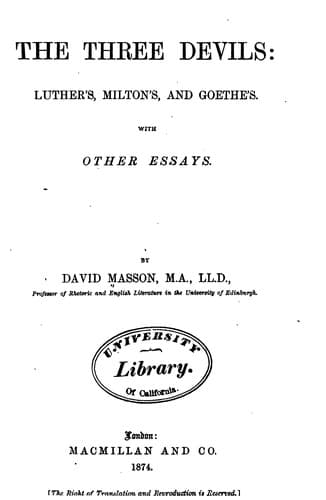
The Three Devils: Luther's, Milton's, and Goethe's; With Other EssaysMasson, David
History
The Three Devils: Luther's, Milton's, and Goethe's; With Other Essays
Masson, David
Devil in literature; Literature -- History and criticism
Thus, passing and repassing between Laracor and London, now lording it
over his Irish parishioners, and now filling the literary and Whig haunts
of the great metropolis with the terror of his merciless wit and with talk
behind his back of his eccentricities and rude manners, Swift spent the
interval between 1702 and 1710, or between his thirty-sixth and his
forty-fourth year. His position as a High-Church Whig, however, was an
anomalous one. In the first place, it was difficult to see how such a man
could honestly be in the Church at all. People were by no means strict in
those days in their notions of the clerical character; but the _Tale of a
Tub_ was a strong dose even then to have come from a clergyman. If
Voltaire afterwards recommended the book as a masterly satire against
religion in general, it cannot be wondered at that an outcry arose among
Swift's contemporaries respecting the profanity of the book. It is true,
Peter and Jack, as the representatives of Popery and Presbyterianism, came
in for the greatest share of the author's scurrility; and Martin, as the
representative of the Church of England, was left with the honours of the
story; but the whole structure and spirit of the story, to say nothing of
the oaths and other irreverences mingled with its language, were well
calculated to shock the more serious even of Martin's followers, who could
not but see that rank infidelity alone would be a gainer by the book.
Accordingly, despite all that Swift could afterwards do, the fact that he
had written this book left a public doubt as to his Christianity. It is
quite possible, however, that, with a very questionable kind of belief in
Christianity, he may have been a conscientious High-Churchman, zealous for
the social defence and aggrandisement of the ecclesiastical institution
with which he was connected. Whatever that institution was originally
based upon, it existed as part and parcel of the commonwealth of England,
rooted in men's habits and interests, and intertwined with the whole
system of social order; and, just as a Brahmin, lax enough in his own
speculative allegiance to the Brahminical faith, might still desire to
maintain Brahminism as a vast pervading establishment in Hindostan, so
might Swift, with a heart and a head dubious enough respecting men's
eternal interest in the facts of the Judæan record, see a use
notwithstanding in that fabric of bishoprics, deaneries, prebends,
parochial livings, and curacies, which ancient belief in those facts had
first created and put together. This kind of respect for the Church
Establishment is still very prevalent. It is a most excellent thing, it is
thought by many, to have a cleanly, cultured, gentlemanly man invested
with authority in every parish throughout the land, who can look after
what is going on, fill up schedules, give advice, and take the lead in all
parish business. That Swift's faith in the Church included no more than
Public-domain text, read in full here on John Shaqi.
Reviews
Reviews
No reviews yet
Be the first to share your thoughts on this work.
Elsewhere in the archive
Join the Discussion
Join the discussion
Sign in to leave a comment or review.
Sign InorCreate an account