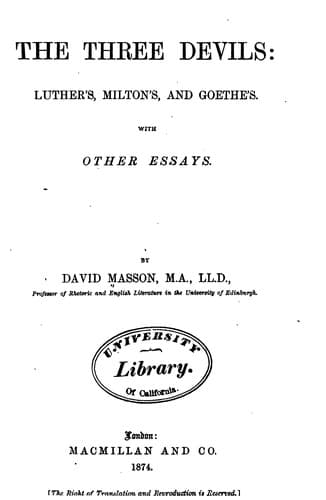
The Three Devils: Luther's, Milton's, and Goethe's; With Other EssaysMasson, David
History
The Three Devils: Luther's, Milton's, and Goethe's; With Other Essays
Masson, David
Devil in literature; Literature -- History and criticism
The year 1710 was an important one in the life of Swift. In that year he
came over to London, resolved in his own mind to have a settlement of
accounts with the Whigs, or to break with them for ever. The Irish
ecclesiastical business of the tenths and first-fruits was still his
pretext, but he had many other arrears to introduce into the account.
Accordingly, after some civil skirmishing with Somers, Halifax, and his
other old friends, then just turned out of office, he openly transferred
his allegiance to the new Tory administration of Harley and Bolingbroke.
The 4th of October, not quite a month after his arrival in London, was the
date of his first interview with Harley; and from that day forward till
the dissolution of Harley's administration by the death of Queen Anne, in
1714, Swift's relations with Harley, St. John, and the other ministers,
were more those of an intimate friend and adviser than a literary
dependent. How he dined almost daily with Harley or St. John; how he
bullied them, and made them beg his pardon when by chance they offended
him--either, as Harley once did, by offering him a fifty-pound note, or,
as St. John once did, by appearing cold and abstracted when Swift was his
guest at dinner; how he obtained from them not only the settlement of the
Irish business, but almost everything else he asked; how he used his
influence to prevent Steele, Addison, Congreve, Rowe, and his other Whig
literary friends, from suffering loss of office by the change in the state
of politics, at the same time growing cooler in his private intercourse
with Addison and poor Dick, and tending more to young Tory writers, such
as Pope and Parnell; how, with Pope, Gay, Arbuthnot, Harley, and St. John,
he formed the famous club of the _Scriblerus_ brotherhood, for the satire
of literary absurdities; how he wrote squibs, pamphlets, and lampoons
innumerable for the Tories and against the Whigs, and at one time actually
edited a Tory paper called the _Examiner_: all this is to be gathered, in
most interesting detail, from his epistolary journal to Stella, in which
he punctually kept her informed of all his doings during his long three
years of absence. The following is a description of him at the height of
his Court influence during this season of triumph, from the Whiggish, and
therefore somewhat adverse, pen of Bishop Kennet:--
Public-domain text, read in full here on John Shaqi.
Reviews
Reviews
No reviews yet
Be the first to share your thoughts on this work.
Elsewhere in the archive
Join the Discussion
Join the discussion
Sign in to leave a comment or review.
Sign InorCreate an account