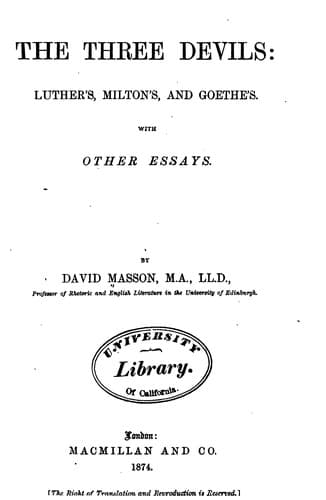
The Three Devils: Luther's, Milton's, and Goethe's; With Other EssaysMasson, David
History
The Three Devils: Luther's, Milton's, and Goethe's; With Other Essays
Masson, David
Devil in literature; Literature -- History and criticism
"When I came to the antechamber [at Court] to wait before prayers,
Dr. Swift was the principal man of talk and business, and acted as
master of requests. He was soliciting the Earl of Arran to speak to
his brother, the Duke of Ormond, to get a chaplain's place
established in the garrison of Hull for Mr. Fiddes, a clergyman in
that neighbourhood, who had lately been in jail, and published
sermons to pay the fees. He was promising Mr. Thorold to undertake
with my lord-treasurer that, according to his petition, he should
obtain a salary of 200_l._ per annum as minister of the English
church at Rotterdam. He stopped F. Gwynne, Esq., going in with the
red bag to the Queen, and told him aloud he had something to say to
him from my lord-treasurer. He talked with the son of Dr. Davenant,
to be sent abroad, and took out his pocket-book, and wrote down
several things as _memoranda_ to do for him. He turned to the fire,
and took out his gold watch, and, telling him the time of day,
complained it was very late. A gentleman said he was too fast. 'How
can I help it,' says the Doctor, 'if the courtiers give me a watch
that won't go right?' Then he instructed a young nobleman that the
best poet in England was Mr. Pope (a Papist), who had begun a
translation of Homer into English verse, for which he must have them
all subscribe; 'for,' says he, 'the author shall not begin to print
till I have a thousand guineas for him.' Lord-treasurer, after
leaving the Queen, came through the room, beckoning Dr. Swift to
follow him: both went off just before prayers."
Let us see, by a few pickings from the journal to Stella, in what manner
the black-browed Irish vicar, who was thus figuring in the mornings at
Court as the friend and confidant of Ministers, and almost as their
domineering colleague, was writing home from his lodging in the evenings
to the "dear girls" at Laracor.
_Dec. 3, 1710._ "Pshaw, I must be writing to those dear saucy brats
every night whether I will or no, let me have what business I will,
or come home ever so late, or be ever so sleepy; but it is an old
saying and a true one, 'Be you lords or be you earls, you must write
to naughty girls.' I was to-day at Court, and saw Raymond [an Irish
friend] among the beefeaters, staying to see the Queen; so I put him
in a better station, made two or three dozen bows, and went to
church, and then to Court again to pick up a dinner, as I did with
Sir John Stanley: and then we went to visit Lord Mountjoy, and just
left him; and 'tis near eleven at night, young women, and methinks
this letter comes very near to the bottom," &c. &c.
Public-domain text, read in full here on John Shaqi.
Reviews
Reviews
No reviews yet
Be the first to share your thoughts on this work.
Elsewhere in the archive
Join the Discussion
Join the discussion
Sign in to leave a comment or review.
Sign InorCreate an account