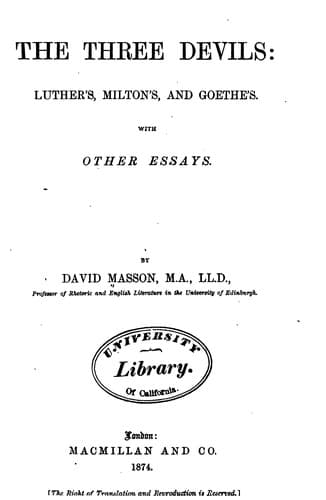
The Three Devils: Luther's, Milton's, and Goethe's; With Other EssaysMasson, David
History
The Three Devils: Luther's, Milton's, and Goethe's; With Other Essays
Masson, David
Devil in literature; Literature -- History and criticism
_March 7, 1711._ "I am weary of business and ministers. I don't go to
a coffee-house twice a month. I am very regular in going to sleep
before eleven. And so you say that Stella's a pretty girl; and so she
be; and methinks I see her just now, as handsome as the day's long.
Do you know what? When I am writing in our language [a kind of
baby-language of endearment used between him and Stella, and called
'the little language'] I make up my mouth just as if I was speaking
it. I caught myself at it just now. * * Poor Stella, won't Dingley
leave her a little daylight to write to Presto? Well, well, we'll
have daylight shortly, spite of her teeth; and zoo must cly Zele, and
Hele, and Hele aden. Must loo mimitate _Pdfr_, pay? Iss, and so la
shall. And so leles fol ee rettle. Dood Mollow. [You must cry There
and Here and Here again. Must you imitate _Pdfr_, pray? Yes, and so
you shall. And so there's for the letter. Good morrow.]"
And so on, through a series of daily letters, forming now a goodly octavo
volume or more, Swift chats and rattles away to the "dear absent girls,"
giving them all the political gossip of the time, and informing them about
his own goings-out and comings-in, his dinings with Harley, St. John, and
occasionally with Addison and other old Whig friends, the state of his
health, his troubles with his drunken servant Patrick, his
lodging-expenses, and a host of other things. Such another journal has,
perhaps, never been given to the world; and but for it we should never
have known what depths of tenderness and power of affectionate prattle
there were in the heart of this harsh and savage man.
Only on one topic, affecting himself during his long stay in London, is he
in any degree reserved. Among the acquaintanceships he had formed was one
with a Mrs. Vanhomrigh, a widowed lady of property, who had a family of
several daughters. The eldest of these, Hester Vanhomrigh, was a girl of
more than ordinary talent and accomplishments, and of enthusiastic and
impetuous character; and, as Swift acquired the habit of dropping in upon
the "Vans," as he called them, when he had no other dinner engagement, it
was not long before he and Miss Vanhomrigh fell into the relationship of
teacher and pupil. He taught her to think and to write verses; and, as
among Swift's peculiarities of opinion, one was that he entertained what
would even now be called very advanced notions as to the intellectual
capabilities and rights of women, he found no more pleasant amusement, in
the midst of his politics and other business, than that of superintending
the growth of so hopeful a mind.
"His conduct might have made him styled
A father, and the nymph his child:
The innocent delight he took
To see the virgin mind her book
Was but the master's secret joy
In school to hear the finest boy."
But, alas! Cupid got among the books.
Public-domain text, read in full here on John Shaqi.
Reviews
Reviews
No reviews yet
Be the first to share your thoughts on this work.
Elsewhere in the archive
Join the Discussion
Join the discussion
Sign in to leave a comment or review.
Sign InorCreate an account