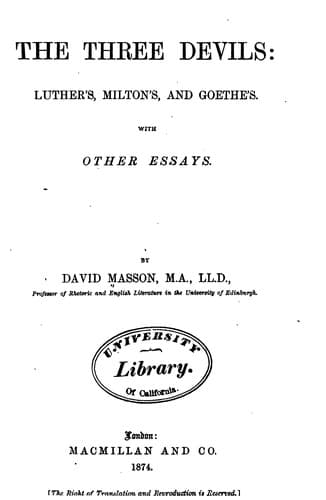
The Three Devils: Luther's, Milton's, and Goethe's; With Other EssaysMasson, David
History
The Three Devils: Luther's, Milton's, and Goethe's; With Other Essays
Masson, David
Devil in literature; Literature -- History and criticism
"Vanessa, not in years a score,
Dreams of a gown of forty-four;
Imaginary charms can find
In eyes with reading almost blind;
She fancies music in his tongue,
Nor farther looks, but thinks him young."
Nay, more: one of Swift's lessons to her had been that frankness, whether
in man or women, was the chief of the virtues, and
"That common forms were not design'd
Directors to a noble mind."
"Then," said the nymph,
"I'll let you see
My actions with your rules agree;
That I can vulgar forms despise,
And have no secrets to disguise."
She told her love, and fairly argued it out with the startled tutor,
discussing every element in the question, whether for or against--the
disparity of their ages, her own five thousand guineas, their similarity
of tastes, his views of ambition, the judgment the world would form of the
match, and so on; and the end of it was that she reasoned so well that
Swift could not but admit that there would be nothing after all so very
incongruous in a marriage between him and Esther Vanhomrigh. So the matter
rested, Swift gently resisting the impetuosity of the young woman, when it
threatened to take him by storm, but not having the courage to adduce the
real and conclusive argument--the existence on the other side of the
channel of another and a dearer Esther. Stella, on her side, knew that
Swift visited a family called the "Vans"; she divined that something was
wrong; but that was all.
That Swift, the Mentor of ministers, their daily companion, at whose
bidding they dispensed their patronage and their favour, should himself be
suffered to remain a mere vicar of an Irish parish, was, of course,
impossible. Vehement and even boisterous and overdone as was his zeal for
his own independence--"If we let these great ministers pretend too much,
there will be no governing them," was his maxim; and, in order to act up
to it, he used to treat Dukes and Earls as if they were dogs--there were
yet means of honourably acknowledging his services in a way to which he
would have taken no exception. Nor can we doubt that Oxford and St. John,
who were really and heartily his admirers, were anxious to promote him in
some suitable manner. An English bishopric was certainly what he coveted,
and what they would at once have given him. But, though the bishopric of
Hereford fell vacant in 1712, there was, as Sir Walter Scott says, "a lion
in the path." Queen Anne, honest dowdy woman,--her instinctive dislike of
Swift strengthened by the private influence of the Archbishop of York, and
that of the Duchess of Somerset, whose red hair Swift had
lampooned--obstinately refused to make the author of the _Tale of a Tub_ a
bishop. Even an English deanery could not be found for so questionable a
Christian; and in 1713 Swift was obliged to accept, as the best thing he
could get, the Deanery of St. Patrick's in his native city of Dublin. He
hurried over to Ireland to be installed, and came back just in time to
Public-domain text, read in full here on John Shaqi.
Reviews
Reviews
No reviews yet
Be the first to share your thoughts on this work.
Elsewhere in the archive
Join the Discussion
Join the discussion
Sign in to leave a comment or review.
Sign InorCreate an account