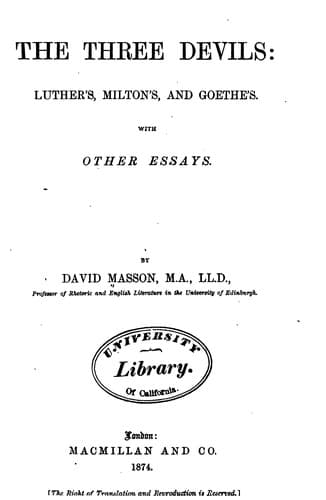
The Three Devils: Luther's, Milton's, and Goethe's; With Other EssaysMasson, David
History
The Three Devils: Luther's, Milton's, and Goethe's; With Other Essays
Masson, David
Devil in literature; Literature -- History and criticism
And now the Almighty determined to create a new kind of World, and to
people it with a race of beings different from that already existing,
inferior in the meantime to the Angels, but with the power of working
themselves up into the Angelic mode of being. The Messiah, girt with
omnipotence, rode out on this creating errand. Heaven opened her
everlasting gates, moving on their golden hinges, and the King of Glory,
uplifted on the wings of Cherubim, rode on and on into Chaos. At last he
stayed his fervid wheels and took the golden compasses in his hand.
Centering one point where he stood, he turned the other silently and
slowly round through the profound obscurity. Thus were the limits of _our_
Universe marked out--that azure region in which the stars were to shine,
and the planets were to wheel. On the huge fragment of Chaos thus marked
out the Creating Spirit brooded, and the light gushed down. In six days
the work of creation was completed. In the centre of the new Universe hung
a silvery star. That was the Earth. Thereon, in a paradise of trees and
flowers, walked Adam and Eve, the last and the fairest of all God's
creatures.
Meanwhile the rebel host lay rolling in the fiery gulf underneath Chaos.
The bottom of Chaos was Hell. Above it was Chaos proper, a thick, black,
sweltering confusion. Above it again was the new experimental World, cut
out of it like a mine, and brilliant with stars and galaxies. And high
over all, behind the stars and galaxies, was Heaven itself. Satan and his
crew lay rolling in Hell, the fiery element underneath Chaos. Chaos lay
between them and the new World. Satan was the first to awake out of stupor
and realize the whole state of the case--what had occurred, what was to be
their future condition of being, and what remained to be attempted. In the
first dialogue between him and Beelzebub we see that, even thus early, he
had ascertained what his function was to be for the future, and decided in
what precise mode of being he could make his existence most pungent and
perceptible.
"Of this be sure,
To do aught good never will be our task,
But ever to do evil our sole delight,
As being the contrary to His high will
Whom we resist."
Public-domain text, read in full here on John Shaqi.
Reviews
Reviews
No reviews yet
Be the first to share your thoughts on this work.
Join the Discussion
Join the discussion
Sign in to leave a comment or review.
Sign InorCreate an account