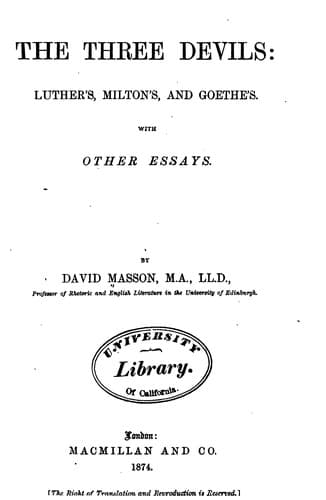
The Three Devils: Luther's, Milton's, and Goethe's; With Other EssaysMasson, David
History
The Three Devils: Luther's, Milton's, and Goethe's; With Other Essays
Masson, David
Devil in literature; Literature -- History and criticism
A scrap or two from
surviving letters will tell the sequel, and will suggest the state of the
relations at this time between Swift and this unhappy and certainly very
extraordinary, woman:--
_Swift to Miss Vanhomrigh: London, Aug. 12, 1714._ "I had your letter
last post, and before you can send me another I shall set out for
Ireland. * * * If you are in Ireland when I am there, I shall see you
very seldom. It is not a place for any freedom, but where everything
is known in a week, and magnified a hundred degrees. These are
rigorous laws that must be passed through; but it is probable we may
meet in London in winter; or, if not, leave all to fate."
_Miss Vanhomrigh to Swift: Dublin, 1714_ (_some time after August_).
"You once had a maxim, which was to act what was right, and not mind
what the world would say. I wish you would keep to it now. Pray, what
can be wrong in seeing and advising an unhappy young woman? I cannot
imagine. You cannot but know that your frowns make my life
unsupportable. You have taught me to distinguish, and then you leave
me miserable."
_Miss Vanhomrigh to Swift: Dublin, 1714._ "You bid me be easy, and
you would see me as often as you could. You had better have said as
often as you could get the better of your inclinations so much, or as
often as you remembered there was such a one in the world. If you
continue to treat me as you do, you will not be made uneasy by me
long. It is impossible to describe what I have suffered since I saw
you last. I am sure I could have bore the rack much better than those
killing, killing words of yours. Sometimes I have resolved to die
without seeing you more; but those resolves, to your misfortune, did
not last long; for there is something in human nature that prompts
one to find relief in this world. I must give way to it, and beg
you'd see me, and speak kindly to me; for I am sure you'd not condemn
any one to suffer what I have done, could you but know it. The reason
I write to you is because I cannot tell it to you should I see you.
For, when I begin to complain, then you are angry; and there is
something in your looks so awful that it strikes me dumb."
Public-domain text, read in full here on John Shaqi.
Reviews
Reviews
No reviews yet
Be the first to share your thoughts on this work.
Elsewhere in the archive
Join the Discussion
Join the discussion
Sign in to leave a comment or review.
Sign InorCreate an account