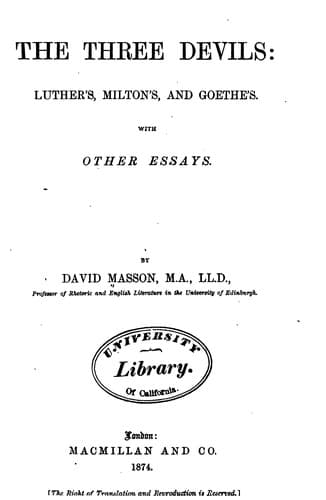
The Three Devils: Luther's, Milton's, and Goethe's; With Other EssaysMasson, David
History
The Three Devils: Luther's, Milton's, and Goethe's; With Other Essays
Masson, David
Devil in literature; Literature -- History and criticism
Here a gap intervenes, which record fills up with but an indication here
and there. Swift saw Vanessa, sometimes with that "something awful in his
looks which struck her dumb," sometimes with words of perplexed kindness;
he persuaded her to go out, to read, to amuse herself; he introduced
clergymen to her--one of them afterwards Archbishop of Cashel--as suitors
for her hand; he induced her to leave Dublin, and go to her property at
Selbridge, about twelve miles from Dublin, where now and then he went to
visit her, where she used to plant laurels against every time of his
coming, and where "Vanessa's bower," in which she and the Dean used to
sit, with books and writing materials before them, during those happy
visits, was long an object of interest to tourists; he wrote kindly
letters to her, some in French, praising her talents, her conversation,
and her writing, and saying that he found in her "_tout ce que la nature
a donnée à un mortel, l'honneur, la vertu, le bon sens, l'esprit, la
douceur, l'agrément et la fermeté d'âme_." All did not suffice; and one
has to fancy, during those long years, the restless beatings, on the one
hand, of that impassioned woman's heart, now lying as cold
undistinguishable ashes in some Irish grave, and, on the other hand, the
distraction, and anger, and daily terror, of the man she clung to. For,
somehow or other, there _was_ an element of terror mingled with the
affair. What it was is beyond easy scrutiny, though possibly the data
exist if they were well sifted. The ordinary story is that some time in
the midst of those entanglements with Vanessa, and in consequence of their
effects on the rival-relationship--Stella having been brought almost to
death's door by the anxieties caused her by Vanessa's proximity, and by
her own equivocal position in society--the form of marriage was gone
through by Swift and Stella, and they became legally husband and wife,
although with an engagement that the matter should remain secret, and that
there should be no change in their manner of living. The year 1716, when
Swift was forty-nine years of age, and Stella thirty-two, is assigned as
the date of this event; and the ceremony is said to have been performed in
the garden of the deanery by the Bishop of Clogher. But more mystery
remains. "Immediately subsequent to the ceremony," says Sir Walter Scott,
"Swift's state of mind appears to have been dreadful. Delany (as I have
learned from a friend of his widow) said that about the time it was
supposed to have taken place he observed Swift to be extremely gloomy and
agitated--so much so that he went to Archbishop King to mention his
apprehensions. On entering the library, Swift rushed out with a
countenance of distraction, and passed him without speaking. He found the
archbishop in tears, and, upon asking the reason, he said, 'You have just
met the most unhappy man on earth; but on the subject of his wretchedness
you must never ask a question.'" What are we to make of this? Nay more,
Public-domain text, read in full here on John Shaqi.
Reviews
Reviews
No reviews yet
Be the first to share your thoughts on this work.
Elsewhere in the archive
Join the Discussion
Join the discussion
Sign in to leave a comment or review.
Sign InorCreate an account